






















“‘Be Kind, rewind’ would be on the DVDs. That was their motto when you walked in,” said Nicole Lawrence in an interview, recalling the Friday night trips she used to take with her kids to Blockbuster. Not a slogan you’d hear today, but for anyone who walked the aisles of the store, it meant something. At its peak, the video rental store had over 9,100 stores worldwide. Today, just one remains in Bend, Oregon. In a world dominated by streaming, Blockbuster’s decline isn’t just a story of a failed business, it’s a symbol of how fast technology has reshaped the way we live and consume culture.
“What’s a Blockbuster? Is that like Ghostbusters or something?” my eight-year-old cousin once asked me, in total seriousness. For Gen Z, Blockbuster is more myth than memory.
Not long ago, though, it was everywhere. In 2004, Blockbuster had 9,100 locations, employed over 84,000 people, and brought in $6 billion in revenue. At one point, the company was expanding so fast that it was opening a new store every 17 hours. It was a place where families spent their weekends, where friends argued over which movie to rent for a sleepover, and where the late fees taught kids their first lessons of responsibility. The rows of VHS tapes and DVDs under off-white buzzing lights weren’t just products, they were part of a shared ritual. But just 16 years later, 9,099 of Blockbuster’s locations have closed, leaving just one to remain.
So what happened?
The short answer: Netflix. The long answer: missed opportunity, overconfidence, and failure to adapt.
In 2000, Netflix was a struggling startup trying to break into the movie rental space with a DVD-by-mail model. Co-Founders Reed Hastings and Marc Randolph knew Blockbuster was the biggest name in home entertainment, so they did what any underdog might: they offered to sell their company–for $50 million to Blockbuster.
Blockbuster’s CEO at the time, John Antioco, rejected them without hesitation. “Blockbuster executives laughed us out of the room,” Randolph tweeted in 2023. At the time, Netflix was unprofitable and still relatively unknown. Antioco reportedly dismissed them as a “niche business,” and said “the dot-com hysteria is completely overblown,” according to Randolph in his 2019 memoir. Randolph now sees the rejection as a defining moment in his career: “I think the more important lesson—a lesson that Blockbuster learned too late—is simply this: ‘If you are unwilling to disrupt yourself, there will always be someone willing to disrupt your business for you.’” tweeted Randolph.
“[Netflix] appealed to only a few customer groups—movie buffs who didn’t care about new releases, early adopters of DVD players, and online shoppers.” according to Clayton Christensen in Harvard Business Review. In other words, Netflix didn’t pose an immediate threat to Blockbuster’s core business. It wasn’t stealing their main customers but, it was creating a new kind of customer altogether. Christensen used Netflix to illustrate a “classically disruptive path,” continued Harvard Business Review. Disruptive innovations often begin by serving a small, overlooked segment of the market. They aren’t immediately better than existing options; they often seem worse by traditional standards. But they are cheaper, more flexible, and more aligned with where consumer behavior is heading.
A significant part of Blockbuster’s business model relied on late fees, which generated around $800 million in revenue in 2000. While the charges were intended to encourage timely returns, they also frustrated customers. “The ugly truth—and the company’s achilles heel—was that the company’s profits were highly dependent on penalizing its patrons,” wrote Forbes. Netflix offered an alternative. Its subscription-based model removed late fees entirely, allowing customers to keep DVDs as long as they wanted for a flat monthly rate. This approach is applied to users who prefer flexibility and convenience over strict return deadlines.
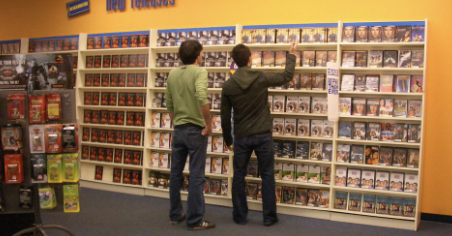
Today, the last Blockbuster store still stands in Bend, Oregon. It operates as both a functioning video rental business and a kind museum. Inside, the walls remain bright yellow, the aisles are lined with DVDs, and a section dedicated to memorabilia from Blockbuster’s peak. Visitors can still rent movies, pick up snacks, and even grab a membership card.
“Blockbuster isn’t necessarily about the actual movies – it’s about the joyful memory of wandering the aisles” wrote Business Insider reporter Molly Allen after visiting the Bend store in 2023.
With 9,099 other locations closed, the Bend store is the last of its kind. Blockbuster in Bend is a reminder of what used to be common: walking into a physical space, flipping over DVD cases, and having to physically purchase a movie before watching. For many younger people, the experience of renting a movie in person is unfamiliar. As media consumption habits continue to evolve, Blockbuster is a reminder of how those habits once looked, and how much they have changed.