


















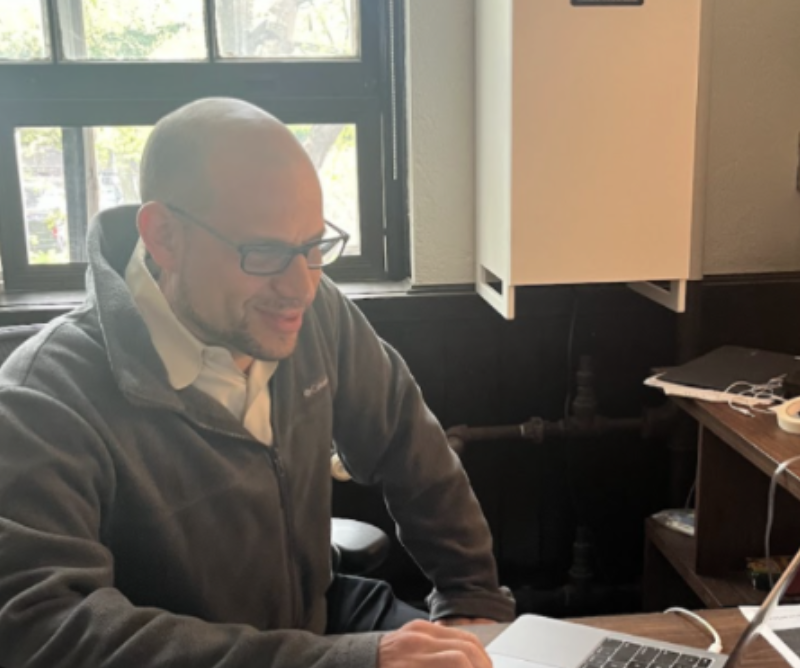

The morning of September 11, 2001, started out as any other day for Keating Crown, a 9/11 survivor and founding trustee of the 9/11 Museum and Memorial board, yet just a few hours later, he ended the day as one of only 18 people to survive from above the South Tower impact zone. After surviving an event that New Yorkers would never forget, making it from the 100th floor to the main lobby, Crown was able to get much-needed medical attention and contact his family. 25 years later, Crown reflects on the experience, “it really put into perspective friends and family, the time that we have together and what we can do for one another.” The support system he had with his parents and girlfriend—now his wife—helped him through this difficult time.
The September 11 attacks on the Twin Towers impacted many New Yorkers’ lives; “today our nation saw evil, the very worst of human nature, and we responded with the best of America,” said President George W. Bush in a televised address to the nation that day. With the hope of the nation at an all-time low, people came together in new ways. At Poly, teachers took students into their houses, doctors rode bikes to the triage area at the Millennium Hotel, and people in the towers helped the injured down the stairs.
Crown grew up in Chicago and went to Duke University. After college, he moved to New York and worked for Aon, an insurance company and risk management firm, as an insurance broker in the South Tower. Six months after the 9/11 attacks, he transitioned to real estate and has been in the business since. Between 2008 and 2011, he received his JD/MBA, which is a dual degree for law and business, from Northwestern University. He now lives in Chicago and works in real estate with his wife and two daughters.
Crown worked on the 100th floor of the South tower. To reach the top floors in the towers, staff had to ride big cable car elevators to a sky lobby on the 78th floor and then transfer to another elevator up to their personal floor. Crown recounts the first tower being hit while sitting at his desk with coworkers. “You could feel our building shake…[and] you could see that big fireball that came out of the south side of the north tower,” he said. Papers flew through the air and rained down on the ground, and people stared up in horror.
As people started to evacuate, an announcement over the loudspeakers told them that the second tower was not in danger and they should return to their desks. However, Crown still decided to call his family in Chicago after looking out the window at the North Tower and seeing “people start jumping out of the building, and people start screaming and crying,” as he put it. Nancy Crown, his mom, picked up the phone, crying. He told her they were evacuating, but he was not in the tower that was hit. Then, Crown and some of his co-workers decide to make their way down to the sky lobby on the 78th floor in the elevator.
In the south side of the sky lobby, his colleagues began making their way to the elevators, but Crown hesitated as he thought to himself: “It doesn’t make sense. When you are in one of these emergencies, you don’t get in an elevator.” Looking over the 250 people on the 78th floor, he noticed someone he worked with and made his way towards him. The colleague, whose name was Kelly, said he was going to go back upstairs to get something from his desk, but just as he headed towards the elevator, Crown’s world was shaken for a second time that day: the South tower had been hit.
As the explosion rocked the building, Crown was thrown onto his face and suffered injuries along his left side, including a broken leg. The plane hit between the 78th and 81st floors, and “just about everyone behind [Crown], where [he] had just walked from, had been killed instantly.” The room was filled with thick black smoke, and Crown couldn’t see anything, including the exit signs. He crawled around through the dark, and the floor was “eerily quiet” except for a couple of people calling out for help, including Crown himself. Crown explains that, “when the plane hit the building, all the jet fuel went down into the elevator shaft and exploded back up.” At the moment, Crown didn’t realize that a spring from the exploded elevators had lodged in his head, causing him to bleed profusely. Despite his injuries, he managed to crawl around in hopes of finding an exit.
As it got hotter and harder for him to breathe through the smog, he began to lose hope. “I just told my mom that I was okay and I don’t think I’m gonna make it,” he thought to himself. Yet right at that moment, he saw a crack of light ahead of him and crawled toward it; someone had opened an exit door. Once he reached the door, he reunited with Kelly, whom he had just been talking to, and they started to go down the stairs together. Only 12 out of over 250 people on that floor survived the initial explosion.
Right as they are about to go down the stairs, they hear the voice of their co-worker, Donna, who was badly burned and wouldn’t be able to make it down herself. Together, Crown and Kelly helped carry her down the stairs, while sustaining injuries of their own. They got down about three or four flights before they started to see people going back up the stairs, telling them the stairway was blocked off. They had a tough decision to make: “[we] looked at each other, and after what we had seen and experienced on the 78th floor, we decided we would not go back up.” When they reached the part of the stairway that had been blocked off, they cleared out the rubble with some other people and eventually continued on. In that confusion, he got separated from his two colleagues, and without knowing if they were ahead of or behind him, he continued on alone.
“I was going down pretty fast, even with a broken leg, about 2 floors every 10 seconds,” Crown says. Another 20 floors down, he ran into three men, “one guy took off his shirt and poured water on it and started packing my back…he said it was pretty bad.” This is around the time the extent of his head injury hit him, and he realizes what he must have looked like. He later learned that there was a spring in his head from the elevators exploding.Once he reached the bottom, he ran into one of his college friends, Alex Kohn, who worked for Morgan Stanley. They stuck together all the way out of the building.
A paramedic grabbed Crown and Kohn and brought them across the plaza to the Millennium Hilton, where a triage area was set up. This is where a paramedic told him there was a spring in the back of his head. Once he was in an ambulance, he saw Kelly and Donna, whom he had lost sight of in the stairwell. They got in the ambulance with him and the ambulance left to take them to the hospital. Approximately three minutes after the ambulance pulled out of the triage area, the South Tower collapsed. The triage area and all the first responders who helped so many people were wiped out by the towers’ fall. A few days later, he reunited with his parents, who drove in from Chicago.
Now Crown lives in Chicago with his wife and children and reflects on the experience. One takeaway he has is to not “sweat the small stuff.” He focuses on spending time with friends and family after an experience in which he wasn’t sure if he would make it. His perspective on what is truly important has shifted. Now he values “the support systems that [he] ha[s] with family and friends differently than before.” Once his daughters were around eight and six, they were playing around with the remote to the TV, and an interview with Crown talking about his experience came on. This opened the discussion of what Crown had experienced. Since then, he has watched documentaries with them and taken them to the 9/11 Museum in New York City to help them learn more about their father’s past.
Crown is a founding trustee of the 9/11 Museum and Memorial Board, which started off as a fundraising board, as a lot of money was needed to build what’s there today. “I thought it was going to be important to have a lasting legacy that people who weren’t alive at the time, or weren’t in the United States, or New York to go and pay respects to those who passed,” he said.
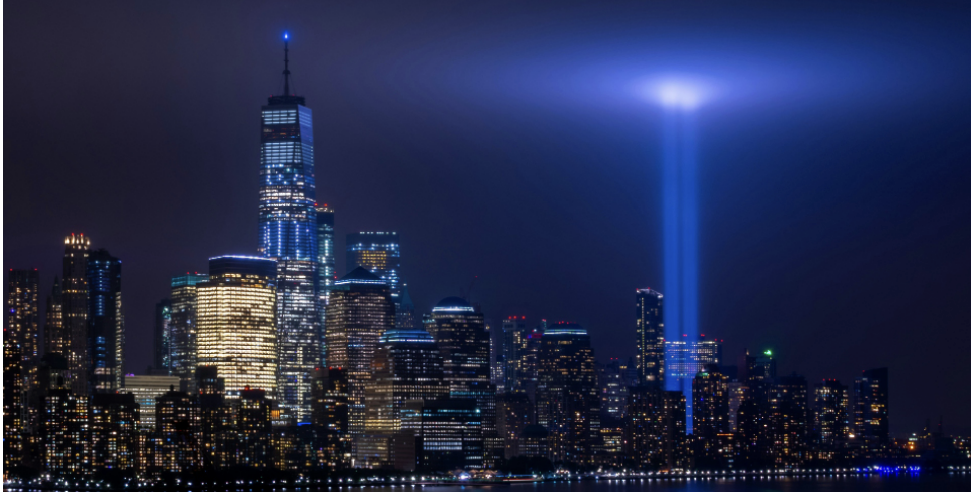
Since that day, there have been many changes in both emergency and fire codes. In airports, security has changed and become much safer. Due to the fact that the exit signs were not visible due to smoke, many buildings have reflective tape on the ground, and speakers have been put in stairwells. Now, with about 9,000 visitors a day, the 9/11 Memorial and Museum “goes a long way in preserving the lasting memory and telling the story about what happened, both what led up to it, as well as how we can honor both the first responders, as well as victims,” as Crown put it.