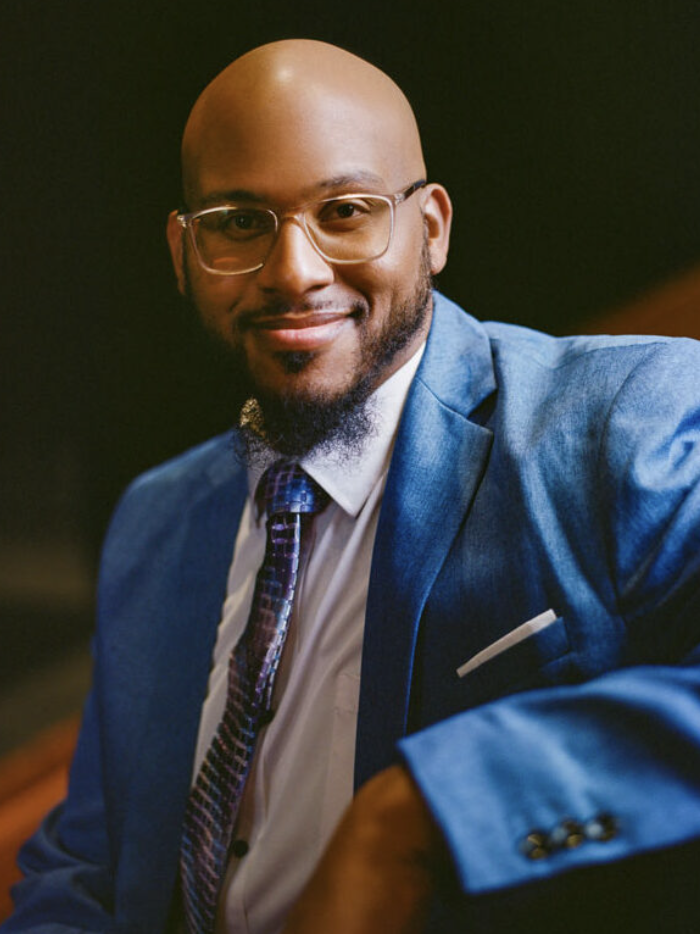
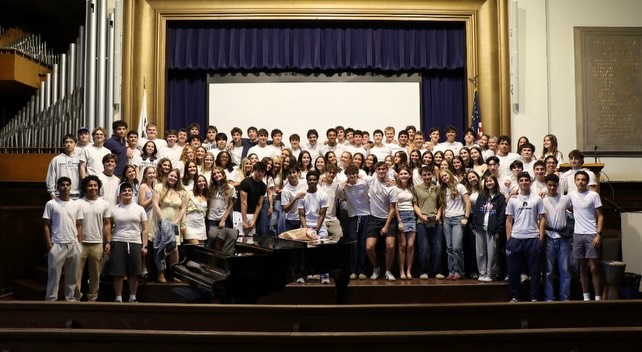











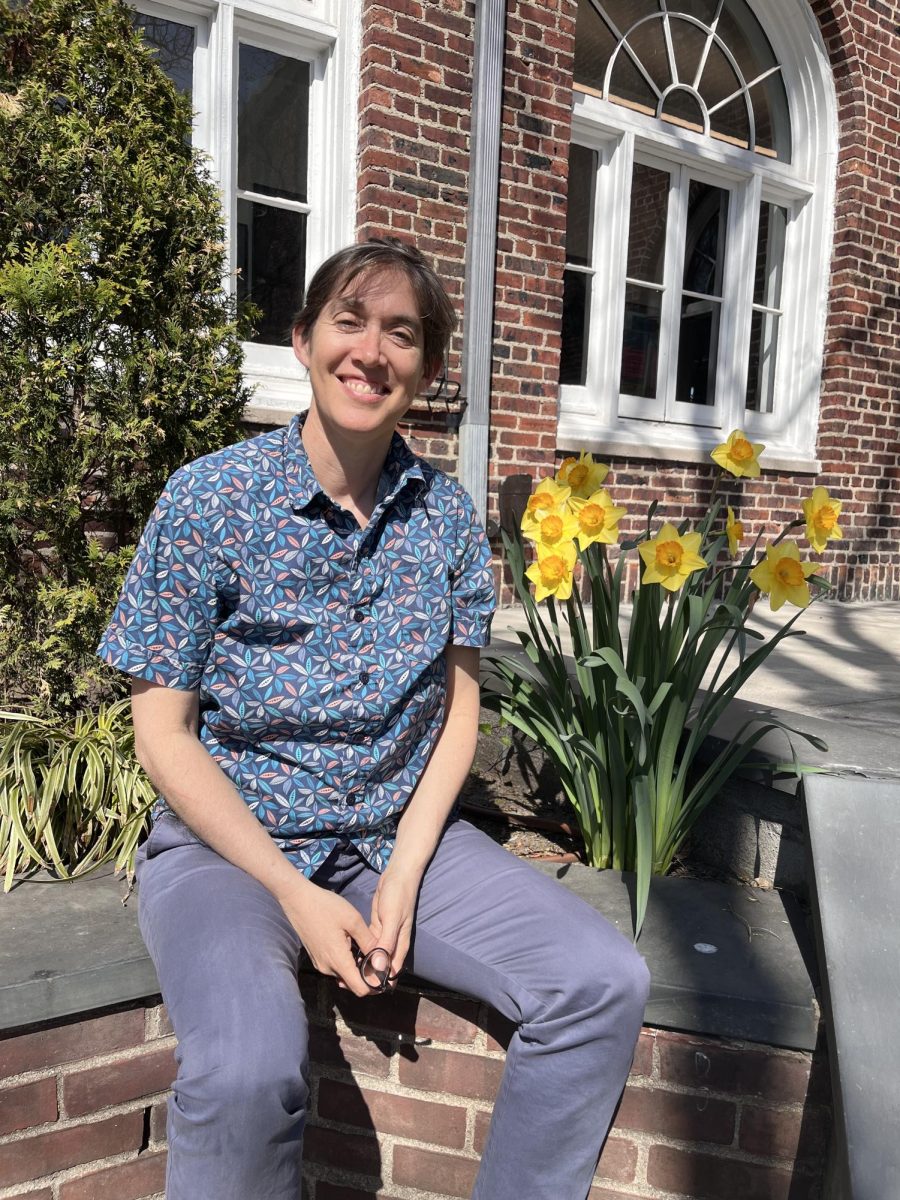
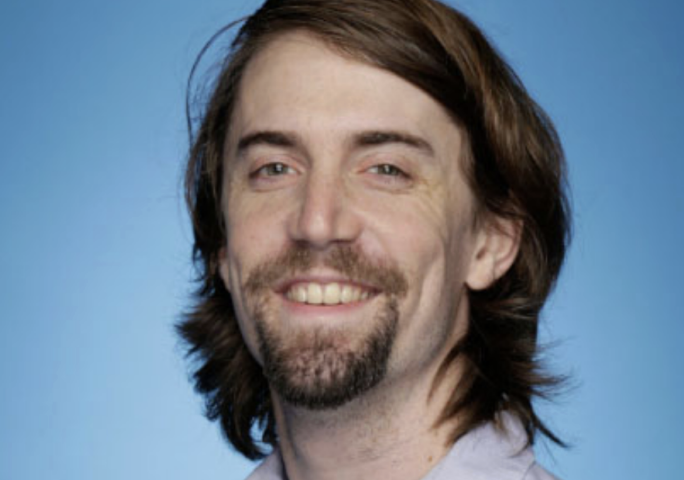
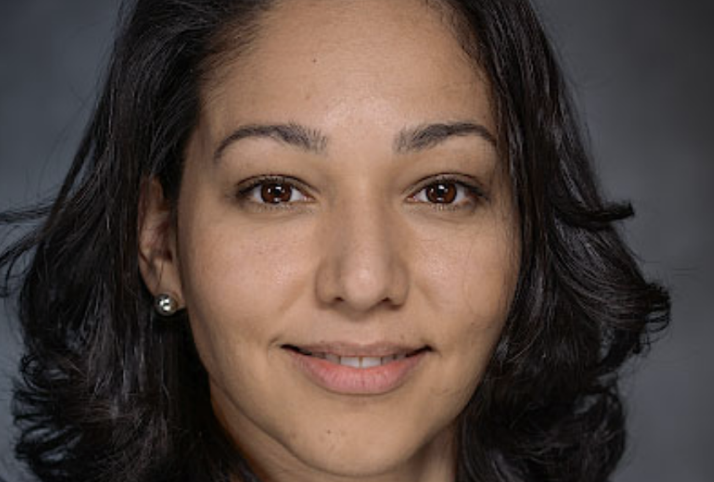





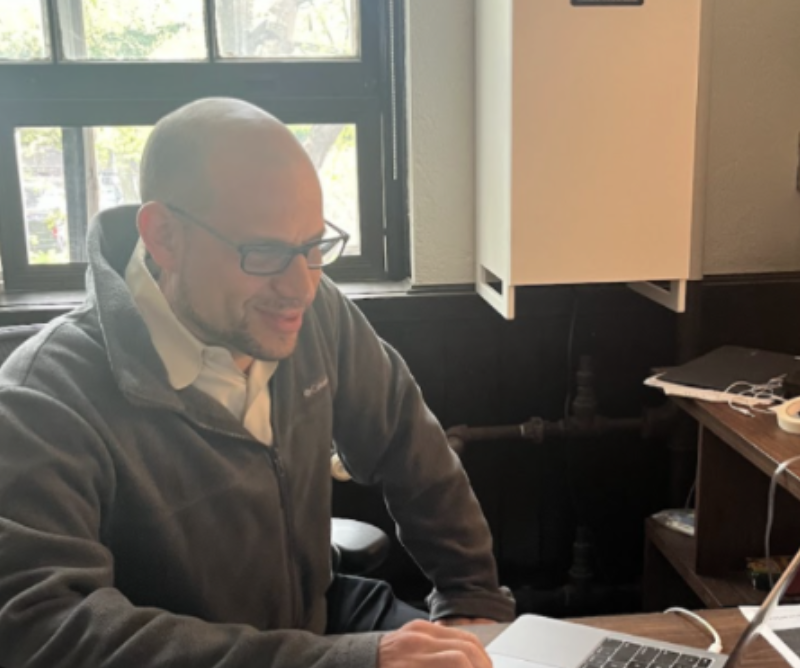

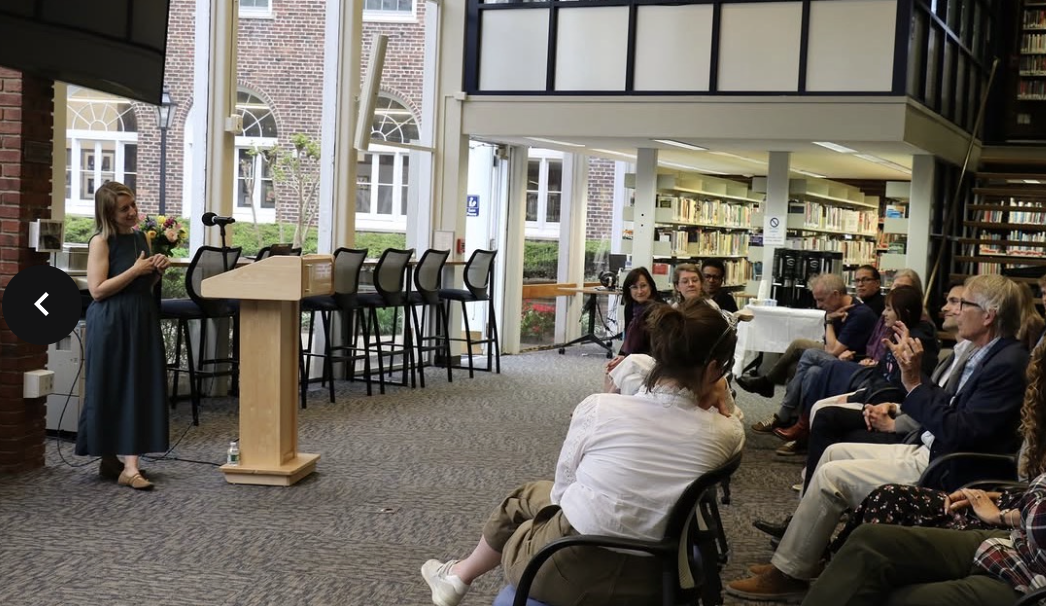
Dr. Virginia Dillon, History Department Chair, delivered this year’s Kastendieck Lecture on May 6 titled “Wires, Waves, and the Web: When Information Moves Faster Than We Do.” The lecture traced the evolution of communication technology from the telegraph to the internet while examining how modern society has become overwhelmed by the very systems designed to connect it. During a time shaped by artificial intelligence, Dillon emphasized the importance of “slowing things down” and practicing careful discernment in an environment that pressures people to move ever faster.
According to Assistant Head of School, Academics Michal Hershkovitz, the annual Kastendieck Lecture has existed for decades, and is named after the former English Department Chair Miles Kastendieck. He was remarked to be “the grandfather of Poly Prep” in his memorial service, according to an article written by the New York Times in 2001. The Poly Prep website shares that the lectures are “made possible through an institutional grant awarded to faculty to advance their professional learning.”
Each year the Kastendieck Lecture enables a different willing member of Poly’s faculty to present research on their topic of choice. The lecturer is selected by five key figures in Poly’s administration: Hershkovitz, Head of Lower School Francis Yasharian, Head of Middle School Daniel Doughty, Head of Upper School Sarah Bates, and Head of School Dr. Noni Thomas López.
The recipient then receives a $3,000 grant from the school in order to supplement their research process, according to Hershkovitz. They are notified approximately a year before the lecture occurs.
“What does it mean to be a scholar?” Hershkovitz posed this question to the audience while introducing Dillon’s lecture. A scholar, Hershkovitz said, is someone “deeply invested in the process and act, really the activism, of learning” — someone who delights in “acquiring, experimenting with, and twisting knowledge until it’s unrecognizable.” Above all, she concluded that a scholar remains “more interested in others . . . than in herself.”
According to Hershkovitz, Dillon embodies those qualities almost effortlessly. Hershkovitz described Dillon not only as a historian of profound scholarship, but also as an educator whose intellectual curiosity is inseparable from the joy she brings to the classroom.
Faculty members echoed that sentiment in written reflections shared before the lecture, with History Faculty Member Timothy Shea calling Dillon “a relentless, joyful evangelist for the gospel of history.”
Hershkovitz explained that the division heads and herself recommend a lecturer before the final selection is approved by the Head of School because the grant is “important [to] our community.”
To apply for the lecture, Dillon submitted an abstract, a research proposal and preliminary sources rooted in a long-standing fascination with communication infrastructure. Or, as she phrased it, “I really like the structures. I like the wires. I like the technologies.”
Although Dillon approached the topic through the lens of past communication systems, its central concerns are unmistakably modern. The core problem she identifies is that “people feel like there is so much going on and they do not know what to do with it,” leading to information being decontextualized, meaningless, or overwhelming in its sheer capacity. Online, Dillon shared that information becomes detached from its authors, place, and time — components essential to fully understanding it.
Technology, according to Dillon, was created to be invisible. Users rarely see the algorithms, structures, or incentives shaping the information they consume. “The buttons we push don’t even make clicks anymore,” said Dillon, referring to current technology’s frictionless nature and how it conceals its own infrastructure. As digital systems have increasingly lent themselves to this, she suggested, users grow more disconnected from understanding how information is filtered, delivered and shaped before it reaches them.
Students today are surrounded by constant information and mistake this exposure for an understanding, despite rarely having time to fully process what they consume.
However, as Hershkovitz noted in a reflection of Dillon’s lecture, “our moment of profound and dislocating revolution in information is not new.” By placing today’s anxieties surrounding artificial intelligence, social media and digital overload within a longer historical pattern, Hershkovitz suggested that society has been repeatedly forced to adapt to technologies that transform how people communicate, learn and understand the world. The challenge, then, is developing the critical thinking and historical perspective necessary to navigate the technological change responsibly.
For many attendees, the lecture resonated because it connected large historical shifts in communication to the realities of modern digital life. Brandon Willabus ’27 said he was especially struck by Dillon’s emphasis on “judgment” and the distinction between simply accessing information and truly understanding it. “There’s just so much out there on the internet,” he added. Rather than accepting information at face value, he said it is important to “deconstruct biases” and remain open to different perspectives.
Dr. Omar Durán-García, History Faculty Member who attended the lecture, similarly said the lecture raised important questions about how technology increasingly shapes human identity and interaction. He noted that communication technologies have become “an extension of ourselves,” particularly in the age of social media and artificial intelligence. Referencing Dillon’s distinction between information and knowledge, Durán said the lecture underscored the importance of maintaining human judgment and critical thinking in an era where people are “bombarded with so much information” that it can become difficult to fully process or critically engage with it.
In many ways, that tension between information and understanding sat at the center of Dillon’s lecture. As Hershkovitz reflected afterward, “To be human is to be complicated. To be a thinker is to think complex and non-binary thoughts.”