
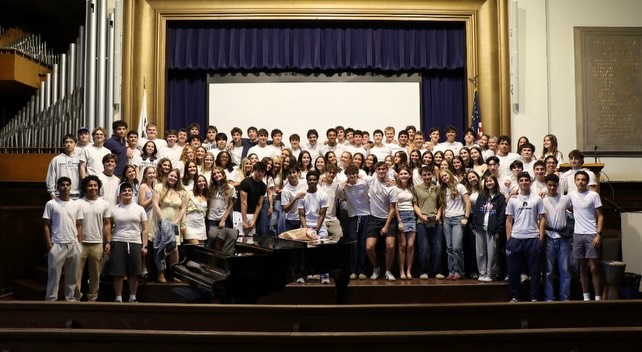
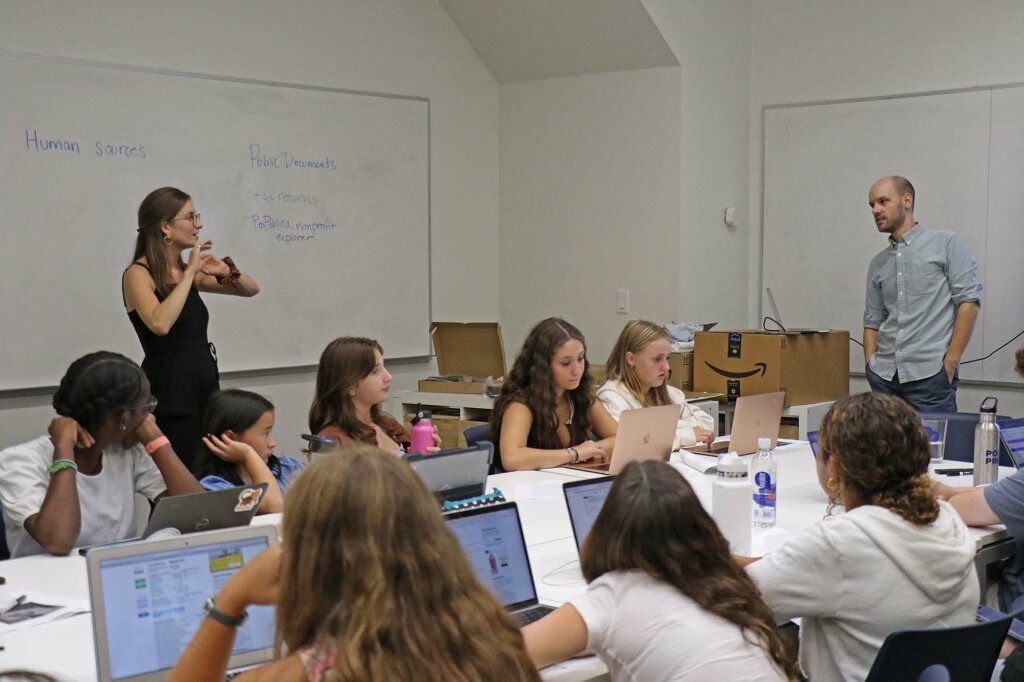
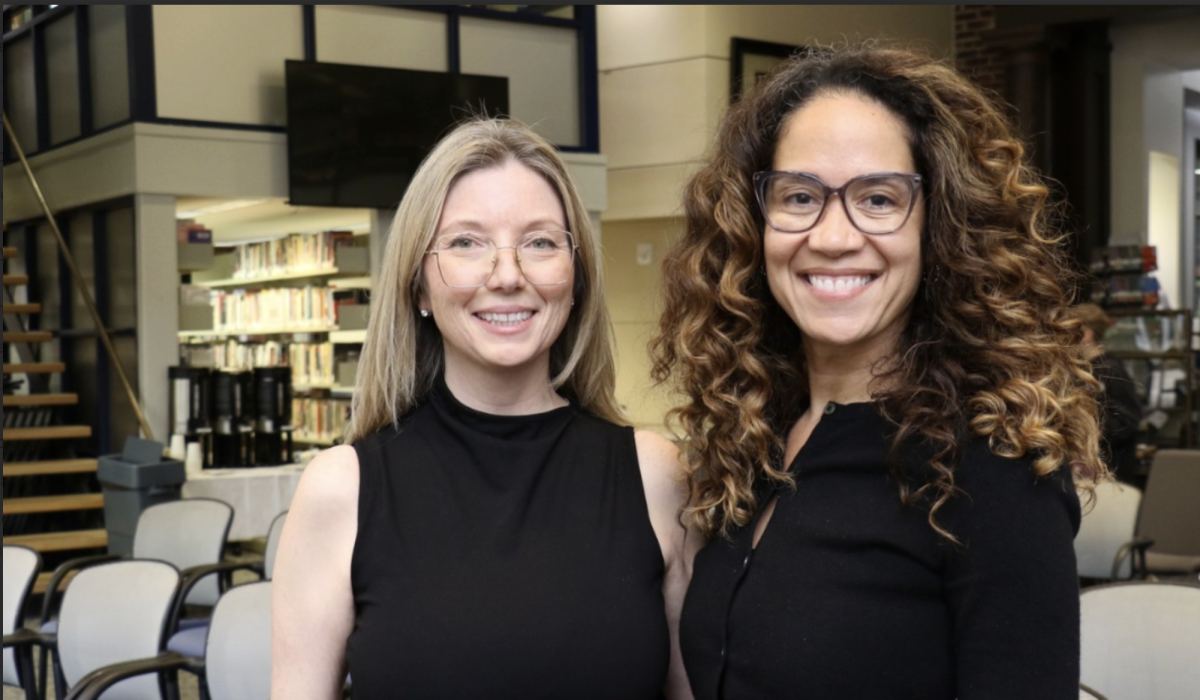





















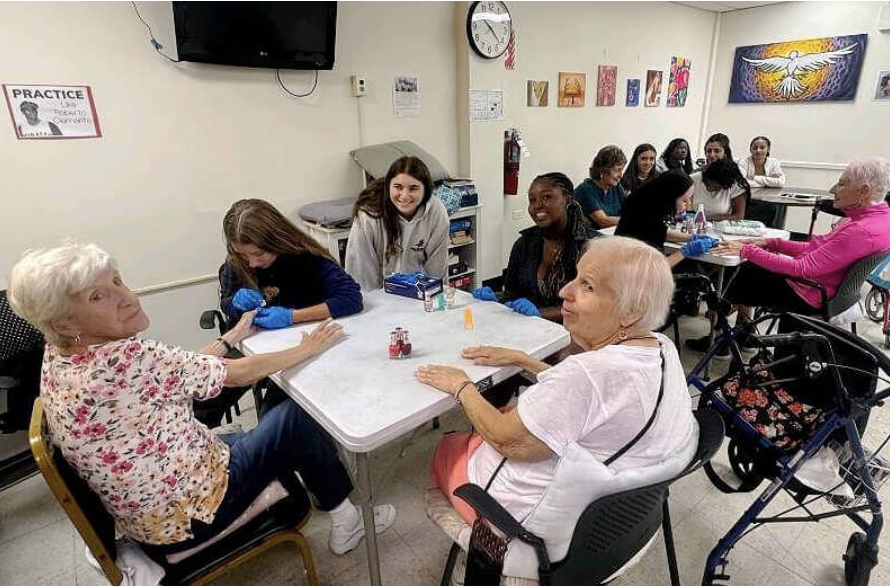
Glamour Gals, one of the new fall Service Learning Teams (SLTs) created and run by Stevie Ziffer ’27, challenged the overall ideology of ageism and the subideology within it that equates youth with beauty. In this SLT, the group 13 of students, including Ziffer and Science Faculty Eman Elhenawy visited the Fort Hamilton Recreation Center to keep the elderly company, while also learning about emotional intelligence and ageist ideologies.
“My goal [for this SLT] was to change people’s perspective on what emotional intelligence is and inform them of the importance of kindness, empathy and self-awareness. I also wanted to bridge a gap between generations through friendship and understanding,” Ziffer said.
“I have a really close bond with both of my grandmothers, one of them passed away a while ago, but my grandma and I were just so close,” said Ziffer, explaining how the idea came about. Ziffer added that she has a close relationship with her other grandmother, too; “I love to hang out with her and she’s so inspiring,” Ziffer said. “So, to think that people don’t really have that [kind of] relationship … or [that they] treat people with prejudice because of their age was very weird to me and I wanted to try to give people the opportunity to have that relationship that was so special to me with my Grandma.” To foster strong connections across generations, Ziffer realized she must combat the idea that hinders these relationships: ageism, which, according to the World Health Organization, “refers to the stereotypes… prejudice… and discrimination… towards others or oneself based on age.”
Some, like Zoey Hawthorne ’29, did not know what ageism was or that it was such a “pending problem” before joining the SLT, according to Hawthorne. In reality, it has unknowingly shaped significant portions of society. For example, according to the American Psychological Association, anti-aging rhetoric “pervades American culture” from “‘antiaging’ face creams to wisecracking birthday cards about getting older to ‘OK, boomer’ memes.” Therefore, “during [the SLT’s] after-school meetings, we talked about ageism a lot—what it was and how it can show up in our daily lives,” Hawthorne said.
Furthermore, Ziffer decided to collaborate with the foundation GlamourGals, inspiring the name of the SLT, which specifically aims to bring companionship to the elderly by encouraging younger girls to give beauty treatments to women in senior centers, according to the GlamourGals Foundation website.
Inspired by the idea of giving older women “beauty makeovers,” as the GlamourGals Foundation calls it, Ziffer decided to more narrowly focus parts of the SLT on the ageism-based notion that people, especially women, lose their beauty as they age. Additionally, Ziffer chose to adopt the beauty makeovers as an activity for the SLT members to do with the seniors alongside the other undertakings the recreation center had to offer.
As Hawthorne reflected, older women often “think negatively about themselves” due to their age. “Trying to make them feel as pretty as they are,” by giving them beauty treatments, “hopefully helps challenge that.” Nyla Moise ’28, one of the SLT members, similarly said, “even if it’s just by something simple, like doing their nails or doing their makeup or giving them face masks, it will make them feel [beautiful].”
However, as Ziffer noted, solely learning about ageism doesn’t necessarily help solve the issue. Therefore, the SLT also aimed to teach students ways to use “emotional intelligence as a way to combat ageism,” Ziffer stated. The students were then able to put the ideas about emotional intelligence they learned into practice. For example, they did this by “talking to [the elderly] and treating them like they’re actual people,” rather than someone who is defined solely by their age, Ziffer said.
“Even though I know how to be social with people, it was really cool how I could see myself using [the] skills [of emotional intelligence] with the women, making me able to empathize with the stories they shared and to connect,” Moise stated.
The experience of going to the recreation center was meaningful to the SLT members. The women were very “enthusiastic” about seeing the students, Hawthorne recollected. Especially when they visited the second time, Hawthorne recalled “one of the ladies, she called a bunch of her other friends who went to the recreation center. She said, ‘The girls are here! Come get your nails done!’ It was really sweet to see that. I didn’t realize they appreciated us that much.”
“It was really fun seeing and talking to [the seniors] partially because we saw that the feeling reciprocated—they were happy to see us too…. [This made it] really nice talking to them because we were both happy to be there,” Moise said.
Furthermore, “Going to the recreation center combated a lot of [negative] stereotypes” about older people, Moise said. “[For example,] there are a lot of stereotypes about how older people are lonely. But, these women were some of the happiest women that I’ve seen in my life,” Moise stated. “Also, before [this experience] I was sort of afraid to get older. But, this made me see that being older is not bad at all, and you’re still able to live your best life being the age you are.”
The experience of creating, planning for, and participating in the SLT “made me realize that [the women we met] had all lived such different and unique lives, and that they were so wise because of it,” Ziffer said. “[I learned] just because you’re older, you aren’t out of touch necessarily. Maybe you’re even more in touch because of the experiences you’ve had.”