


























 A week into winter break, I opened my computer, remembering that upon returning to school, I would be overwhelmed by schoolwork in preparation for midterm exams scheduled in January. I found myself caught between two options for how to spend my last days of break: I could relax with family so I would return to school well-rested, or I could begin preparing for the assessments I would take in January. I quickly found it hard to relax, knowing I would soon be tested on a semester’s worth of information.
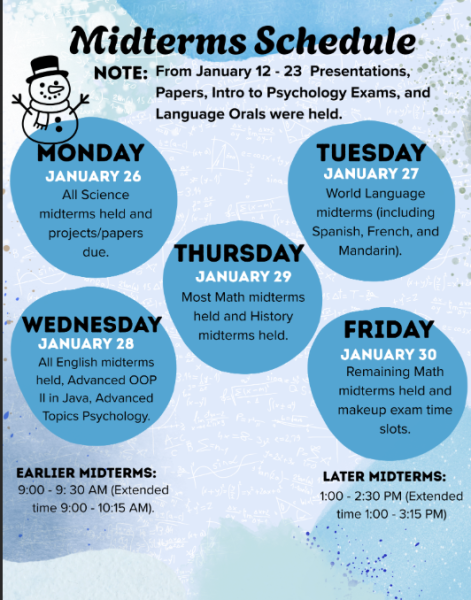
Since 2022, midterm exams at Poly Prep have taken place after winter break, with a full week in January dedicated to testing. This year, “Presentations [took place] over the weeks of January 12-23, and other projects and papers [were] due throughout the week of January 21,” according to the exam schedule Head of Upper School Sarah Bates digitally sent out in December. Additionally, “all sit down exams [took] place during the last week of January.”
The current schedule doesn’t allow students sufficient time to fully relax during winter break while also ensuring they perform well on their exams.
I know many students find themselves unable to decompress over winter break, anxiously awaiting the return to school, where they are expected to remember expansive material in preparation for exam week. The Ethical Culture Fieldston School follows a similar, yet slightly more abrupt, midterm schedule, with exams beginning the second week after the break. As a result, students “leave for the holidays after a stressful couple of weeks only to face the same thing when they return,” according to a 2024 editorial from The Fieldston News. “If we just did [finals] before, I could actually have a relaxing break,” asserted Fieldston student Molly Coulston in an interview with The Fieldston News.
75% of high school students experience constant academic stress, according to statistics published by Crown Counseling, a therapy service. Additionally, “60% of students feel overwhelmed by their academic responsibilities,” according to an article from SUNY Cortland’s student newspaper, The Dragon Chronicle. “This kind of pressure can have major impacts on mental health, contributing to high levels of stress and anxiety,” the piece furthered. As a result, time away from school, such as winter break, is crucial for students to rest and recharge. It is “the time for students to relax and unwind from the constant pressure and stress of school, some staying at home or going on vacations,” according to a 2017 op-ed from Montgomery County’s Premier Student Newspaper, The MoCo Student.
Nonetheless, with midterm exams and projects looming, it is often difficult to relax, as many fear forgetting material and scoring poorly on exams. As a result, some students study during the break in preparation for testing. “The point of midterms and a big psychological aspect is that you go on break and feel the relief of being done and then enjoy your break and come back ready for second semester,” said then student Laila Baluk in a 2023 interview with The Polygon. Having the stress of midterms during the holidays defeats the purpose of the break because it is difficult to relax.
Many universities maintained a similar exam schedule through the 1970s: students would leave for winter break in December and return for final exams in January. However, this perpetuated much stress for students. Specifically, “For years, students at Harvard have found themselves spending part of their winter breaks preparing for final exams in January,” according to a 2008 article from Insider Higher Ed. During the 1980s and ‘90s many universities nationwide altered their semester calendar in hopes that students would not dedicate their winter break to studying. Harvard was one of the last universities to change its testing schedule in 2008. Now, Harvard also begins the first semester earlier, generally in late August or early September, so it can conclude with finals before winter break begins in December, according to the article from Insider Higher Ed. A common concern among Poly’s administration regarding altering the testing schedule is that the two semesters will no longer be equal in length. “We want to assure roughly between ten and 11 cycles per semester,” said Assistant Head of School, Academics Michal Hershkovitz. “Otherwise, one semester’s work is not equal, or not equitable in terms of another semester’s work, and most importantly, the students are cheated from having the time needed to process units and readings and problem sets and experiments and all the wonderful things we do in classes.” There is no way to resolve both issues of prolonged student stress during the holidays and uneven semesters. However, scheduling midterms during the last week of December would significantly benefit the student body, allowing us to clear our heads and have a relaxing two-week break. I acknowledge that this means we would have slightly less time for instruction during the first semester; however, the benefits to students’ stress levels outweigh this drawback.