






























 Jennifer Wallace, New York Times bestselling author and award-winning journalist, addressed Poly Prep’s Middle School, Upper School, faculty, and families about academic overachievement this October. Many Upper Schoolers, in particular, saw themselves in the stories and statistics Wallace shared; however, they also felt like they couldn’t use Wallace’s advice to improve their habits and approaches towards school.
Across individual lectures with different members of the community, Wallace discussed the struggles of students at “high-achievement” institutions such as Poly, as well as the unhealthy habits students adopt in an effort to succeed academically. She also explored the concept of “mattering —the feeling that we are valued by others and add value to others—and not solely equating self-worth with academic success, as a way to counteract students’ stress and the pressure they often feel.
According to Upper School Counselor Anais Kingsberry, Wallace was handpicked by Poly’s Student Support and Counseling Faculty to address concerns and patterns they have seen among Poly students. “Our team was very excited and interested in Jennifer Wallace’s research and her approach to addressing the toxic achievement culture and the high levels of pressure that students were facing,” said Kingsberry. Wallace’s visit also wasn’t intended to be an isolated event. “Her visit is part of what we hope will be a continued conversation about ‘mattering’ on campus,” added Kingsberry.
During her talk with the Upper School, Wallace drew on and shared the interviews with families and students she conducted all over the country for her books “Never Enough: When Academic Culture Becomes Toxic—and What We Can Do About It” and “Mattering: The Secret to Building a Life of Deep Connection and Purpose.”
“I asked parents if they’d be willing to be interviewed for the book [“Never Enough”], and hundreds of parents reached out, and so that’s where I began to do my research,” said Wallace in an interview with the Polygon. “I interviewed kids from public schools, private schools–on Zoom, in person, with their families around, sometimes without their families around– in a variety of ways.”
At the assembly, Wallace presented her findings and research to students. She highlighted stories of students overwhelmed by overachievement, such as a girl who stayed up so late at night doing work that she ran with her eyes closed during her track practice, and another student who, with his family, decided to discuss college admissions for only an hour each week to reduce stress and anxiety about the process. Wallace emphasized both the good and bad of high-achieving environments and aimed to share solutions by highlighting the students who mitigate pressure in their lives and thrived, such as the latter example. “I really focused on the kids who were doing well despite the pressure. I knew there was a problem. I documented the problem. Researchers had documented the problem, but then I really wanted to have solutions, and so that was where I spent the majority of my research,” said Wallace. Her solutions included getting more sleep, not equating academic performance to self worth, and not focusing on a college’s prestige or name during the application process.
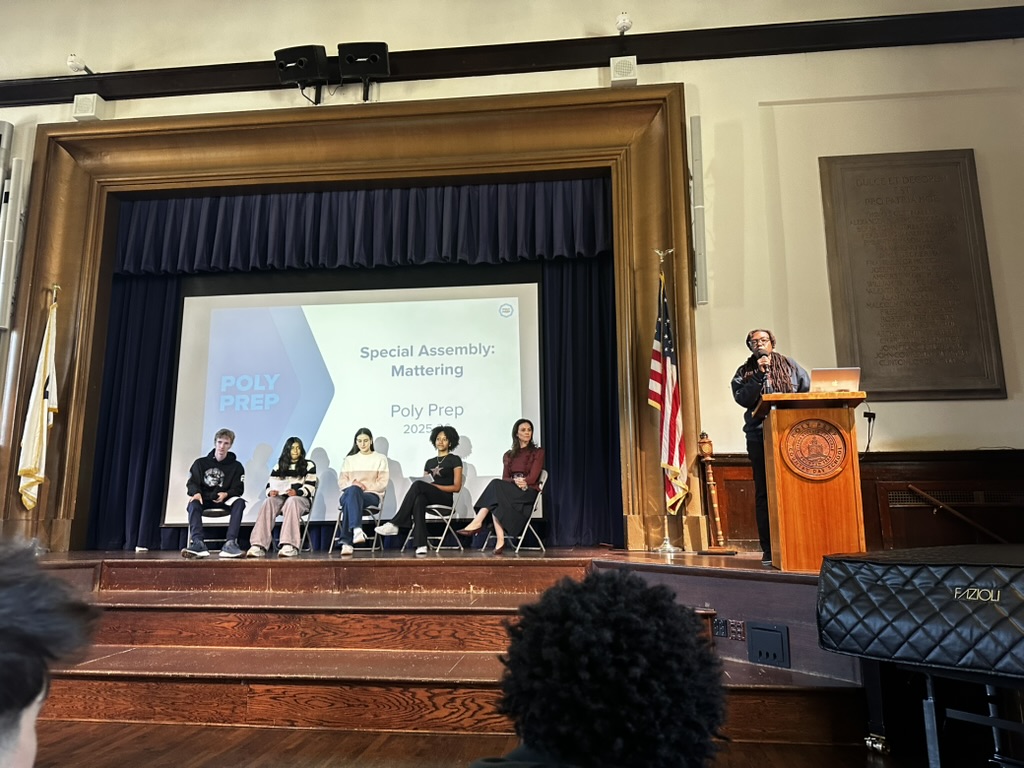
Wallace opted for a panel-style conversation when addressing the Upper School. “I like a panel. I like it to be a conversation; when I’m speaking with young people, I like to be interviewed by young people,” said Wallace. Alongside Wallace, there were four different students: Ryan Speaker ’27, Lalitha Jayaram ’28, Eliza Rorech ’26, and Sarai Dudley ’26. These students asked Wallace questions about her research, books and the lives of students. “I got an email from Mr. Marks saying ‘would you be interested in doing this [panel]?’ and I was happy to sign on to it,” said Speaker.
Following Wallace’s talk, many students reflected on how her message related to their own lives and experiences at Poly. A survey sent out to Poly Upper School students on Wednesday, October 22, received 75 responses, and about 43% of respondents either agreed or strongly agreed that Wallace’s talk was meaningful. “I do think [the talk] was beneficial. And I feel like not hearing it from our teachers or our Head of School but someone new, who has a lot of experience in this field, was actually helpful,” said Jayaram.
Jayaram’s sentiment was reflected by students across the Upper School, as corroborated by the fact that they resonated and identified with the issues that Wallace mentioned. According to a survey conducted by the Polygon, 71% of students either agreed or strongly agreed with the statement “I do feel like Poly Prep is a ‘high-achievement’ institution and often struggle with academic pressure,” and only 35% of students either agreed or strongly agreed that they get enough sleep. However, students also expressed that Wallace didn’t necessarily give them the tools to fix the issues they acknowledged they were experiencing. Specifically, only 23% of students agreed or strongly agreed with the statement “Jennifer Wallace presented solutions and information that I feel I can implement and will benefit from.”
“I think students don’t really have a choice to not get sleep. You have to do your homework, you have to do your tests, you have to take care of your future. But I think it’s rather, the school system that is making all these students not get any sleep,” said freshman Clara Sarcos. Many students, like Sarcos, felt as though their sleep schedules and academic habits were a product of external factors as opposed to their own accord. “Just telling a bunch of high schoolers to get more sleep when they have so much work, when they have all of these stressors in their life, plus going to a school that’s so oriented in sports and has so many students doing extracurriculars, that’s kind of not possible at all,” said Charlotte Kessler ’27, another student in attendance at Wallace’s talk. When Wallace opened up the conversation to the audience, both Sarcos and Kessler contributed, raising questions about their own struggles with the issues Wallace explored.
In response to what Poly students expressed in surveys and interviews, Wallace agrees that larger systems are to blame for student stress, and many students may not have found her talk beneficial because they are so ingrained in these systems. “I think, perhaps, the feeling like they’re not able to implement changes is because they feel like the systems around them are too strong, and they don’t feel that they have individual agency to make changes,” said Wallace. To do so, Wallace implores students to seek out their trusted adults and have conversations about the changes that need to be made to combat the stress and pressure they’re feeling.
Kingsberry shared that students may have difficulty visualizing themselves using Wallace’s solution due to pressure and stress that they feel. “I think part of it could be that, at the moment, [students] weren’t sure of how they would implement what [Wallace] shared…they may not be sure what it would look like for them to get more sleep,” said Kingsberry in response to the survey results.
Wallace’s talk highlighted the realities of stress and underscored how difficult necessary change can feel within larger high-achievement systems, which offer both validation and challenge for many students. As the Poly community continues to reflect on Wallace’s message, the question of how its members can work together to ensure that achievement and well-being truly coexist remains.