





























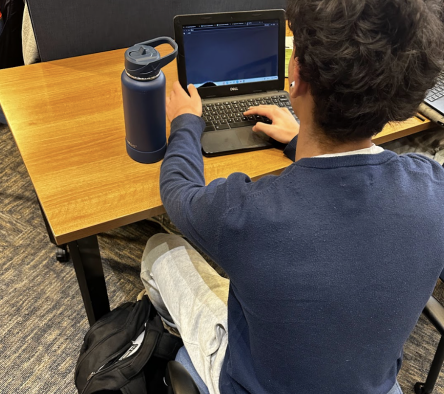
This fall, fifth graders stepped into middle school with one major change: their Chromebooks now stay in the classroom. The new policy has reshaped how students complete homework and interact with technology compared to past years — and administrators say the decision came down to two central concerns.
“Those are the two main factors — the weight of their backpacks, and then mitigating the interaction with technology a bit,” said Daniel Doughty, Head of Middle School.
Now, with the new policy, teachers dictate when students are allowed to access their computers. Since they are no longer given their own Chromebook to keep with them until eighth grade, which was customary up until this year, each classroom that hosts a fifth grade class has a Chromebook tower.
The reasoning behind the new policy
Fifth graders, the youngest and smallest students on campus, have often struggled under heavy backpacks. Not yet familiar with the seven-day block rotation, they “would keep every single thing in their bag all day,” according to Doughty. Both he and Middle School Dean Nkenge Walcott described frequent complaints from parents that “cited medical concerns with the size of the fifth graders and the weight that the backpack was adding,” said Doughty. Walcott added, “their little bodies were quite literally crumbling under the weight of these really heavy Chromebooks.”
Additionally, there was this desire to “reduce the [fifth graders’] interaction with technology,” according to Doughty. This stems from a broader concern among adults that, “excessive … screen exposure is linked to lower academic performance, sleep disturbances, attention problems, lower self-esteem, and higher risk of depression and aggression,” , according to the American College of Pediatricians (ACP). Doughty added, “these things become very addictive, especially in that age where their brain is still very developmental.”
Teachers have also noted the issue of “gamification,” as Melinda Lvovsky, the fifth grade English teacher, described it. Students would arrive early to class, just to pull out their Chromebooks and play games, and they would continue to do so for the entirety of the class period.
The ways in which this policy has impacted fifth-grade classrooms
Teachers were given “a little bit of a warning” about this shift, in order to give them some amount of time to reorganize their class plans and curricula, as Annie Pulsipher, a fifth grade History teacher mentioned.
For Corinna Brathwaite’s fifth grade math classes, the shift has had minimal impact. Her students complete homework in workbooks, and class time is typically spent reviewing the homework assigned from the previous day (which has been completed in students’ workbooks). Usually she will integrate Chromebooks into the class periods, as once the classwork and discussion has ended, she assigns work on IXL, a platform the company characterizes as a personalized online learning platform with real-time feedback on interactive practice problems on their website, for them to complete.
For Lvovsky, this means that she had to make a pretty dramatic change to her style of teaching: from using largely online material to hard copy resources, like grammar packets within her English classes. Additionally, the students’ limited access to technology has prevented Lvovsky from utilizing Poly’s new subscription to vocabulary.com. The platform, which the company describes on their website as a branch of the IXL learning program that helps users build their vocabulary, was something she had hoped to assign for homework. She largely credits her comfortability with the adjustments she’s had to make to the help of Jean Bernieri, who is an assistant teacher for all of her fifth grade classes. “Because I have her in the classroom with me now… if I need to go make photocopies or do something else I can, whereas in the past, if I did not have her… that would significantly impact my lesson,” she notes.
The change has had similar effects on Noreen Malik’s fifth grade science and Pulsipher’s history classrooms.
Pulsipher notes that she’s seen her students “learn often better” without the distractions presented by their Chromebooks. Although, sometimes class calls for online activities, where students are advised to take out their computers from the tower. But the reality is that these students aren’t “digitally savvy,” as Pulsipher puts it. They have had difficulty navigating and signing in to their Chromebooks, taking up an unexpected amount of class time.
Students and teachers alike have cited the issue of homework assignments as one of their major challenges. Without assured consistent access to Google Classroom, teachers don’t always deem it necessary to post their homework for the night — relying heavily on students to write things down in their planners. As one fifth grade student, Simon Wagenberg, explained, “If we forget to write something in our planner, it’s really hard to get the homework, and I’ve missed a few homeworks because of that, so it’s just really inconvenient.” Furthermore, teachers are no longer allowed to assign homework digitally.
Students as a whole have largely agreed that not having access to a personal Chromebook makes school work harder. Fifth grader Zane Shetty expressed that they felt as though the new policy was “really unfair,” especially since the “current sixth graders got to [have their own].” They added that, on nights when they get home late, it becomes difficult to finish digital assignments — work that teachers expected students to complete during the school day (either in-class or to spend a few minutes on in the beginning of the day or during recess) but that sometimes spills into after-school hours. “I’ve been home late sometimes, and I don’t have enough time to finish all my assignments. So it makes it a lot harder if I don’t have a Chromebook with me,” said Shetty.
Without the distraction of Chromebooks, students are now “ able to connect more . . . they’re able to talk with one another . . . they’re just managing a little bit differently, [but they’re still gaining those same skills],” Walcott remarks, explaining that the Middle School Dean team views the change as a net positive.