








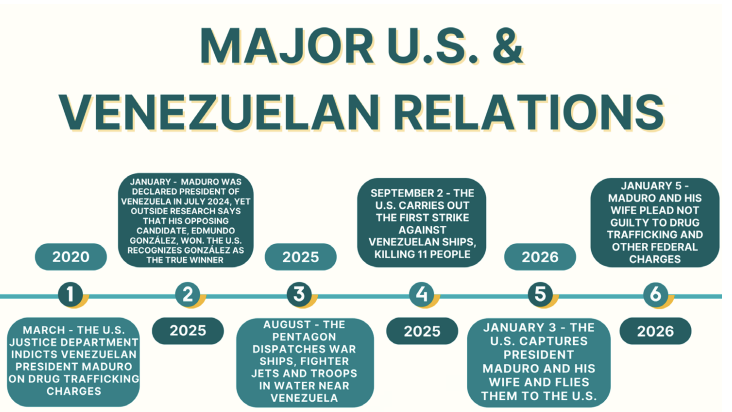
A U.S. military operation abducted and detained the President of Venezuela, Nicolás Maduro, from his home in Caracas on charges of “narco-terrorism” on January 3, according to Time Magazine. Following the arrest, U.S. President Donald Trump has said that the U.S. will run the country, has seized control over Venezuela’s oil industry, and appointed Delcy Rodríguez, Maduro’s Vice President, as the country’s Interim President, prompting concerns from political figures about foreign overreach and the future of regional stability.
Maduro’s kidnapping comes after months of U.S. spies monitoring him under a military operation titled “Operation Absolute Resolve,” which is part of an ongoing initiative under the name “Operation Southern Spear,” according to the political research platform, Council on Foreign Relations. The article continues that, as per official U.S. announcements, Southern Spear is an attempt to stop drug trafficking in Latin America and has been used to justify both Maduro’s arrest and recent strikes on foreign cargo ships in Venezuelan and Caribbean waters.
However, the unprecedented nature of this operation and Maduro’s abduction have sparked
debate about the legality of the Trump administration’s foreign intervention. “The use of military force against another nation is not allowed under international law, except in self-defense in response to an armed attack, and Venezuela had not attacked the United States,” said Political Scientist and Professor Michael Albertus via the University of Chicago News. “Nor is it permissible to conduct a law enforcement operation in another country without that country’s consent, because doing so has the potential to lead to war,” he said.
Venezuela’s United Nations Ambassador, Samuel Moncada, furthered this sentiment by deeming the U.S. operation as “an illegitimate armed attack lacking any legal justification” at a United Nations Security Council meeting, days after the abduction, according to the International Council on Transnational Justice. Cuba, Russia, Mexico, Denmark, France and other countries at the meeting echoed this claim, joining the growing calls from activists, politicians and citizens to stop U.S. interference.
Poly Prep’s UNIDAD President and Middle School Editor of the Polygon Felipe Santiago ’26 also shared how his affinity group had concerns about the legality of Maduro’s arrest and the broader military operations conducted under Southern Spear. In doing so, he shared that UNIDAD was able to understand the event’s importance because of its potential implications for both the Venezuelan people and U.S. relations. “It’s important for us to talk about these things because we do have… people who may be affected, even if not personally.”
However, contrary to much of this criticism, there have been celebrations by Venezuelan citizens who are rejoicing in Maduro’s removal. “In the news, [some] Venezuelans are celebrating the overthrowing of Maduro, [as] we know he was a very oppressive dictator,” shared History Faculty Dr. Omar Durán-García, who teaches Latin American history courses. Maduro’s dictatorship often manifested in human rights violations, such as killing anti-government protestors in security clashes, according to the BBC. However, Durán-García adds that this celebration is not mutually exclusive with concern about U.S. expansion.
“Many Venezuelans and other activists or politicians in Latin America are [also] concerned about what the aftermath will be,” he said. “In the past, we have had multiple instances where the U.S. has either provided financial support or training to military groups that are fighting to overthrow particular…governments that the United States thinks [are] too leftist for their own interest,” which has led to “thousands of disappearances…political persecution, [and] killings, and this is a recurring trend” continued Durán-García. Given Maduro’s affiliation with the United Socialist Party of Venezuela, Durán-García shared that similar objectives may be fueling today’s attack on the country.
Another historical element being used to justify today’s intervention is the desire for oil. In an interview with CBS News, Trump said that “Venezuela unilaterally seized and sold American oil,” and has used this to justify possession of Venezuelan oil deposits following Maduro’s removal. While Venezuelan oil deposits did not belong to the U.S., Durán-García explained that oil companies owed the U.S. government money due to regulation fees, and that “some critics say that that’s also the reason why Trump was willing to take over and try to run this country” said Durán-García.
Despite its rich historical context, however, what makes this attack on Venezuela novel is its intensity. “The biggest difference is precisely that we haven’t seen a military intervention that has ended up in the abduction and the arrest of a leader, which is the case of Maduro,” Durán-García furthered. “Although there have been past instances where drug violence… has been used as a way to justify U.S. presence intervention, we have not seen this level of aggression and intervention in the political system of a sovereign nation like it is in Venezuela,” said Durán-García.
“We’re in a different historical moment, and the United States is actively participating in [an] overthrowing or implementation of a new form of rule that is out of the current political zeitgeist,” concluded Durán-García. “This is not the standard.”