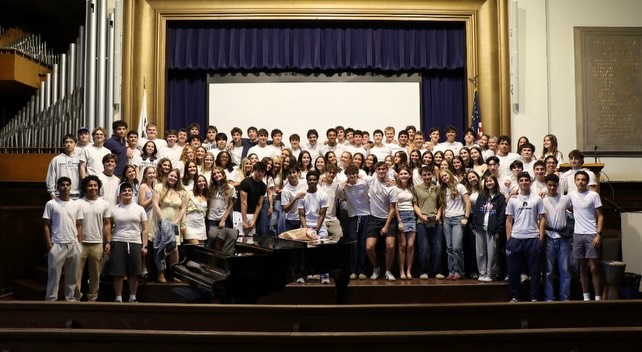














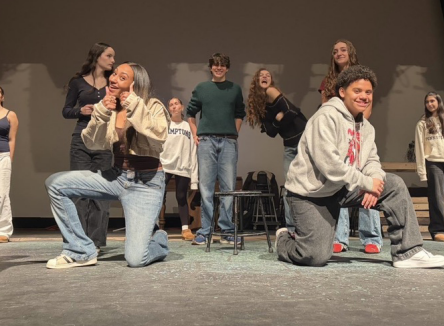





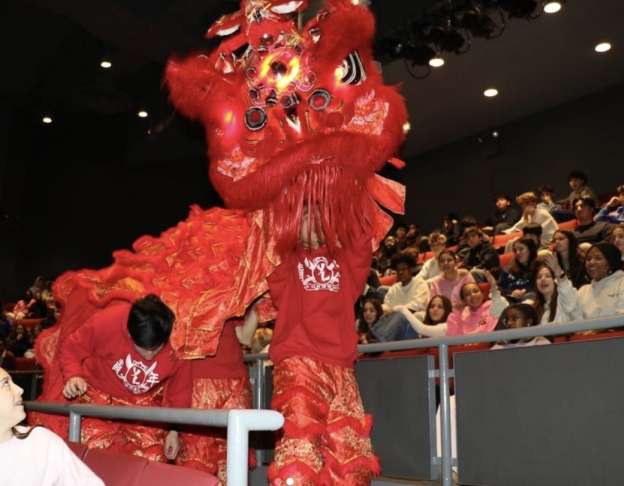

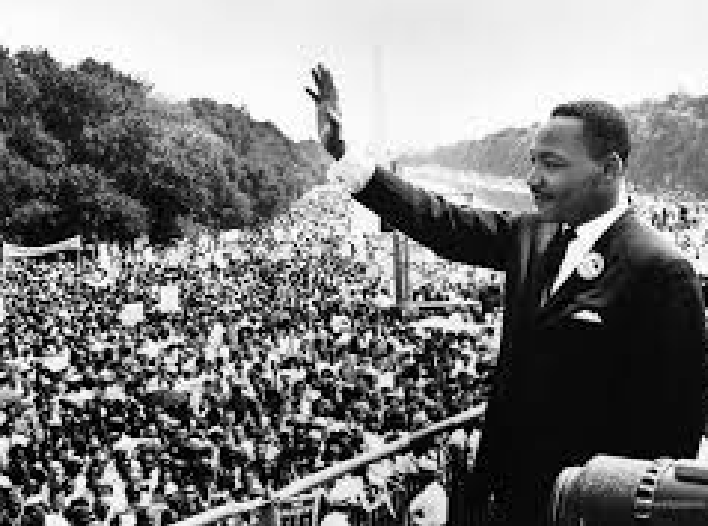
The annual Martin Luther King Jr. Day Assembly, presented by Director of Campus Library Services and Upper School Diversity, Equity, Inclusion and Belonging Co-Coordinator Iman Stultz in Chapel on Friday, January 16, featured a collaborative format rather than the narrativized style of prior years. Specifically, rather than presenting a single narrative, this year’s assembly featured mini-presentations from each affinity and alliance group, exploring Dr. King’s contributions to the human rights movement as they relate to their respective groups.
Stultz decided to implement the shift for the assembly. She said that, traditionally, the Lemonade Affinity Group (Black Women’s Affinity) has been solely responsible for conducting the assembly. However, Stultz added that in recent years, the group has expressed that they do not have enough time to do both the MLK Day assembly and the Black History Month Assembly, which they also organize and hold in February.
Concern about workload of building multiple presentations prompted a transition that began with last year’s assembly, where MLK Day was commemorated in a way that leaned away from the traditional autobiographical format. Rather than being run by Lemonade, the assembly “was presented by the newly formed Race in Film Club and offered a unique perspective on King’s message by exploring the representation of Black Americans in the media,” according to a 2025 Polygon article.
Throughout the assembly, audience members and leaders examined depictions of Black Ameri-
cans in film, television, and other media. This year, the assembly expanded on last year’s shift but approached remembering King’s message differently. Stultz said this format of including every DEIB Group “shows that Dr. King’s message belongs to everyone, not just one community, and it helps students see how different identities connect to the work of justice. It models that creating a more equitable school is a shared responsibility.”
Stultz led this year’s assembly and opened with a quote from Dr. King: “Injustice anywhere is a threat to justice everywhere,” capturing the essence of the message that his work connects to every DEIB group. “The way we’re doing it this year adds a different perspective to how we celebrate Dr. King,” said Lemonade Co-Leader Kaya Freeman ’26.
The assembly felt especially relevant to the Poly community, given the politically contentious environment in the U.S, where people may be feeling more inspired now by Dr. King’s message. “Dr. Martin Luther King Jr. was interested in demonstrating what it means to fight for what you believe to be right without fists or guns. I think that’s a powerful message for the world today,” said Dean of Students Jared Winston. “The social and political issues that we have going on in this country and around the world that can be really enraging some-
times,” continued Winston.
Stultz added that Dr. King is especially inspiring to her recently. “The social and political issues that we have going on in this country and around the world that can be really enraging sometimes,” she said. In early December, Stultz and Science Faculty Eman Elhenawy sent out an
email to all group leaders, according to Freeman. In the email, Stultz and Elhenawy explained that this year, each leader would prepare and present a slide on how Dr. King’s message contributed to their group’s civil rights efforts. While creating his presentation, UNIDAD Leader Felipe Santiago ’26 said, “We found out that his [King’s] message of peace connected a lot to what Dolores Huerta and Cesar Chavez were trying to do.”
In late December, before winter break, Stultz and Elhenawy held a meeting with all leaders to discuss their slide plans. After Winter Break, leaders and their groups discussed their slides during early January DEIB blocks with other members, integrating others’ ideas into
their presentations. “We asked them, if they had to make their slideshow, what would it be about,” said Freeman. Stultz said the assembly aimed to remind students that “we are all in this together.” This sentiment was shared by many students who either led the presentation or listened to it.
Elyse Bogaty ’28, a student in attendance, said, “I learned a lot about Dr. King’s message and how he helped the broader human rights movement.”