



























On a rock climbing trip with his summer camp, 14-year- old Elijah Sivin sat back in his harness as he thought about how he would get past the chimney move he was stuck on. The other campers had already finished the climb, and he had to figure out how to get through a chimney, the first move of that climb, to make it to the top. After 15 minutes or so, he finally got through it and completed the rest of the climb with ease. In the end, it was all worth it when he was rewarded at the top by the view of the vast trees below.
In recent years, rock climbing as a sport has become increasingly popular, with a 2021 growth rate of over eight percent that surpassed the past 11 years, according to the Climbing Business Journal. Since he was a child, Sivin always knew he was interested in climbing, whether in the Shawangunk Mountains or along the railing of the stairs of his Cobble Hill brownstone. However, despite the immense joy that comes with rock climbing, there is also a demanding mental aspect to the sport.
Climbing can produce stress, which manifests differently in each person. According to Springer Nature, a website for scientific and educational journals, “a total of 48.4% of rock climbers (39.1% men, and 61.6% women) reported at least moderate levels of symptoms of stress.” This stress often comes from frustration with yourself. While some people may see this as a negative, it can also have positive effects, such as building determination and perseverance. Though he doesn’t always, Sivin tries to move past this frustration, acknowledging that what is challenging can also help you grow. Additionally, he incorporates this mindset into his teaching.
Before he started climbing, Sivin ran on his high school track team. “You would have a significant goal in X amount of time, and that would structure what you were doing to get ready for it.” Sivin compared this to climbing, which is much less structured than running – for most climbers, goals are self-imposed rather than set by a competition or event.
“[I like] organizing my activity over time,” said Sivin. “As an adult, it’s like, ‘okay, we’re going to go to Colorado and we’re going to climb this summer, so let me try to get in shape.’” Because of the structure this approach provides, Sivin tends to be more consistent when there is a long-term goal.
Sivin explained that his experience with nerves around climbing stems from the noticeable lack of safety or security. Because of this, he sometimes sticks to the easier climbs. “I want to eliminate the risk of getting hurt to absolute zero, [but] I know at the end of the day, I don’t feel like I did that much.”
On a trip to the Adirondack Mountains, Sivin climbed with a guide named Don Mellor, known by some people as the “Dean of Adirondack Climbing,” according to Sivin. Mellor, despite being an excellent climber, was around 70 at the time, with a noticeable tremor in his hands. Although this caused Sivin some concern about the guide’s reliability on a challenging climb, he was able to acknowledge it and work with it. “I actually remember talking to him this summer … like, especially if we do a one off day, I’ll probably be pretty nervous most of the day, but as soon as we’re done, I want to try it again.”
For Sivin, physical challenges can also be mentally challenging. ScienceDirect says that “climbing at one’s limit causes more anxiety and increased effort compared to climbing below one’s ability.”
“I know there are some days that I go to the gym and I just want to do the easiest ones because I don’t feel like getting nervous,” said Sivin. However, there are also days when he feels more confident and attempts to climb what he might consider intimidating. “I think it’s okay to have days where you don’t go all out. It helps highlight those times when you do.”
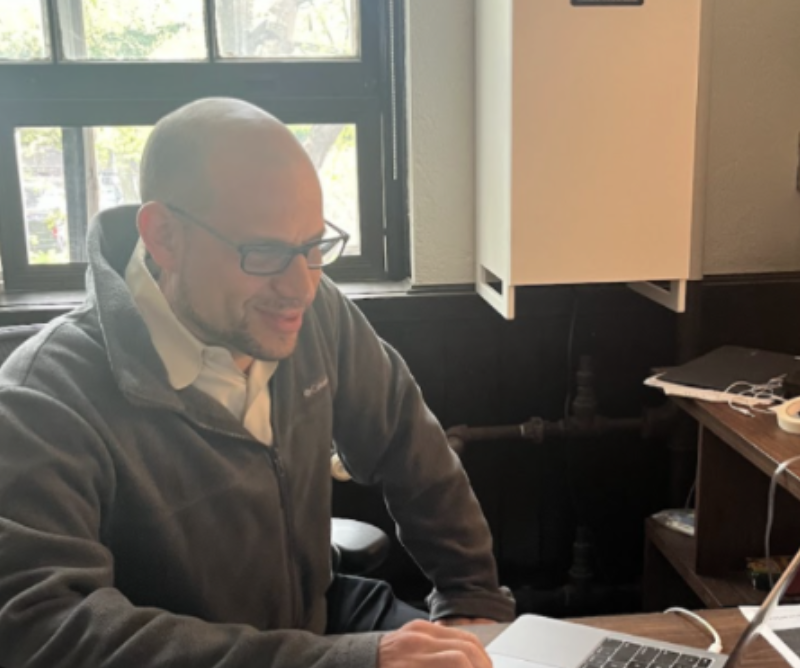
Sivin uses climbing “as an analogy for challenge and level of difficulty with work” when talking to students. He turns the challenges he has faced with uncertainty into advice for when a student feels overwhelmed or confused by work.
“He has a real desire to know and understand all of his students,” said Chair of the History Department, Virginia Dillon. “He tells students you’ve got to work through problems, you’ve got to take routes that don’t work and paths that don’t work.”
As a teacher, Sivin helps students plan their work in a structured way, asking questions to spark new ideas for achieving their goals. This advice is prevalent in climbing, given the many ways you might approach a climb.
“That idea of identifying a challenge that your whole self understands, like being way off the ground and having something that at least feels potentially dangerous, you’ve got a new perspective,” he said.
With this new perspective, Sivin tries to find work they will be proud of. “The thing that’s challenging is probably going to be a thing that you’re going to be working on, and that can be interpreted as discouraging,” Sivin said. “But another teacher here introduced me to a stoic expression, I believe a Roman historic philosopher who said the obstacle is the way.”