
























By the time the college acceptance letter hits the inbox, something else quietly slips away: urgency. The late nights feel less necessary, the red pen less threatening and for many seniors, putting forth their best academic effort suddenly seems optional. After years under the weight of grades, peer competition and the promise that everything hinges on getting into college, some students exhale and loosen their grip on perfection. The pressure that once defined their routines loosens, and with it, the constant drive to prove themselves. Some lean into that relief. Others don’t: they keep pushing, fueled by a genuine curiosity. This split exposes what has truly motivated students throughout high school and what it means to be a student with ambition.
“It is a human instinct, or maybe even a human need, to take your foot off the gas, to take a breath. Take a look around. Stop stressing.” Emily Gardiner, Upper School Deans Department Chair; Director of College Guidance, said — noting that she empathizes with her senior students and their slump in motivation post-college decision.
What Gardiner describes highlights a pattern commonly associated with burnout. Burnout is the “chronic response to stress in life,” according to PubMed Central, a biomedical journal in the U.S. National Institutes of Health’s National Library. The phenomenon of burnout leads to exhaustion, cynicism and inefficacy — all of which typically lead to reduced effort in an individual’s studies, resulting in lower performance.
Students who experience burnout are more likely to report a decline in sleep as well, according to PubMed Central, as poor mental health, which only serves to exacerbate the issue. Poor mental health “can affect a student’s energy level, concentration, dependability, mental ability and optimism, hindering [academic] performance,” according to the Suicide Prevention Resource Center. This perpetuates a vicious cycle, one that students can carry into college and into their adult life.
Where does academic stress come from?
In 2025, 52% of senior students reported that their stress was caused by applying to college, according to a survey conducted by CollegeData, an online college and scholarship database and advisory service from 1st Financial Bank USA. 53% reported that it was the almost-herculean task of writing essays, both putting thought into word and the juggling of perhaps dozens of essays with a regular school courseload. 49% of respondents who identified applying to college as their primary source of stress also reported being “highly stressed,” with 26% saying they were “extremely stressed.”
The senior students at Poly Prep have reported something similar: “[The college application process] was really, really stressful. . . my whole summer was just consumed with writing really long applications,” said Amara Johansson ’26.
Beyond just the act of applying to college, many students report feeling that every little grade they receive carries significant weight and the potential to damage their overall Grade Point Average (GPA) starting in the latter part of junior year. As a result, students often approach their work with a heightened sense of pressure, constantly calculating how one score might affect the bigger picture.“If I bomb this test, that will affect my grade, and that grade’s getting sent directly to colleges. So, every single assessment means so much, or at least you build it up to be,” said Anna Brandmeyer ’26.
Poly teachers have also noted that they see this stress in their classrooms: “There’s a sense that that’s what senior year should be devoted to. It’s getting into college, and so the school [aspect] of senior year isn’t perceived as significant like it is for other years. . . I think the idea of being intellectually engaged and an active participant in the classes sometimes takes a backseat,” said English Faculty Rebekah Delaney.
How does that stress change once students are accepted?
The majority of Poly seniors applied to college through early decision (ED) or early action (EA) programs. Since 2016, the percentage of students applying to ED or EA has increased from about 41% to 80%, according to a 2022 Polygon article.
The College Board distinguishes ED as an application to an individual’s “first choice” college, which serves as a binding commitment upon acceptance, and EA as the regular admissions process, only that results are released in January or February. In contrast, the regular decision process allows students to apply to multiple colleges with decisions usually released later in the spring. They claim that there are several benefits to applying either EA or ED, most significantly that it “reduces stress.”
Our seniors appear to agree with this sentiment: “Once I received that [acceptance] letter, I was like, ‘man it’s gonna be a breeze [from now on],’” said Michael Menegatos ’26.
Johansson agreed, adding that she can attribute her now relaxed state to the fact that “I’m legally bound [to college] no matter what.”
The teachers at Poly certainly see this sentiment reflected in their senior students, especially as the year progresses and we get into the spring semester. There was an emphasis from teachers on keeping expectations regarding grades similar to those at the beginning of the fall semester, but many have expressed sympathy for these students.
“I think it is a really exciting, joyful feeling of getting in somewhere and feeling like your hard work paid off, and wanting to celebrate and live in that moment,” said Mathematics Faculty Oryan Brown.
Fred Montas, English Faculty, describes this shift in seniors’ attitude as “a recognition of where you are in your life, and that you are moving onto another stage. So, it’s part of a transition in some extent.” He added, “Where it gets concerning is when it starts affecting multiple aspects of a student’s life, where they’re less engaged socially, where they’re not meeting their responsibilities and obligations, where they give off this kind of energy that makes it hard for others to be around them.”
Brandmeyer has acknowledged the tendency for some seniors to withdraw socially and academically and has tied addressing that to her role as Student Body President. She said she hopes to help foster stronger connections within the senior class and shift the focus away from academics as the center of students’ lives. “I would say that I feel it’s my responsibility to make sure that collectively we’re engaging with each other and strengthening that senior class bond,” she said. Brandmeyer added that she wants the Class of 2026 to feel like one large friend group where everyone is happy to spend time together. “I think that less stress leads to more friendship and laughter. Things like that are so important for every high schooler, especially seniors,” she said.
Brandmeyer’s idea is backed by science: a review of 38 studies found that friendships, especially high-quality ones that provide social support and companionship, significantly predict well-being and can protect against mental health issues such as depression and anxiety, according to the American Psychological Association.
Why do students try so hard at school when they almost instantly feel better once they stop?
The answer lies in what many psychologists and educators now call achievement culture: a system in which success is expected and relentlessly pursued.
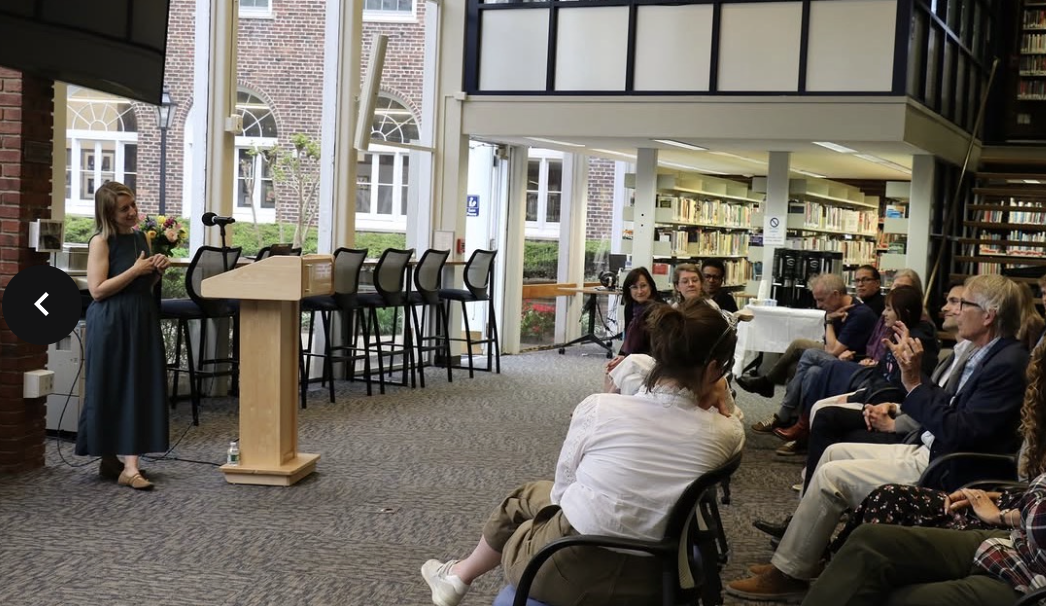
In her book “Never Enough: When Achievement Culture Becomes Toxic,” Jennifer Breheny Wallace examines how the pressure to excel has reshaped childhood, particularly in high-performing schools. Juliet Moretti, Head of Student Support, Health and Wellness, noted in her opening statement for the meeting the Learning Support Team hosted for the parents, in collaboration with Wallace that “Today’s students face unprecedented pressure to succeed. The drive to optimize performance has resulted in skyrocketing rates of anxiety, depression and self-harm in teens and adolescents.”
This pressure rarely stems from malicious intent. Noni Thomas López, Head of School, said during the meeting, that parents have told her that their “biggest hope, their biggest desire, is for their child and their future [and] is that they are happy and that they are a good person.” And yet, somewhere between that hope and the reality of daily life, happiness can become secondary to achievement.
Today, achievement seems to define so many young people, far more than it did for their parents’ generation. “In 2019, there were two national policy reports that named most at-risk youth for negative health outcomes. They named children living in poverty, children with incarcerated parents, children of recent immigrants with few resources, children living in foster care and then they named a new at risk group: children attending high achieving schools,” Wallace said during the meeting. “These are public and private schools around the country that are well-resourced, where the kids go off to competitive four year colleges. The students attending these were now officially ‘at risk,’ meaning they’re two to six times more likely to suffer from clinical levels of anxiety and depression.”
For many of them, the reason is that all of their motivation is extrinsic. As described by Psychology Faculty Ron Sarcos, “we are extrinsically motivated when the motivation stems from achieving something. . . we may not necessarily enjoy it, but we do it because we’re, for example, getting paid for it.” In this case, academic success is often expected of many students who want to be accepted into prestigious colleges.
During the research for her book, students that Wallace interviewed, who experienced primarily extrinsic motivation, described having absorbed the message that their worth — their value, their “mattering” — is inseparable from what they accomplish. Success can feel like proof that they deserve love and respect. Failure, by contrast, can feel like an indictment of their character.
Johansson noted that without her parents encouraging her to maintain her grades, she would not have continued to try as hard as she had before, and that the only reason she tried in the first place was to get into college.
“I think [my level of motivation] has definitely changed, probably for the worse. Because, after you get in. . . [you] did it all. The school work that comes after [getting into college] is done with half a mind, rather than how it was like before, when you were trying to get in.” Menegatos added.
“In the fall, there is a lot of emphasis on every little grade, and I get that students all across the grade spectrum. The extra high overachievers and the students who historically have not done super well in math all want to start the year off being able to submit something good to colleges,” said Brown. “Once decisions start coming back, that level of really trying to make sure you get every point drops off for a lot of students, and they’re a lot more chill about not getting the grade they wanted.”
While teachers assign grades, they ultimately hope students come to school because they enjoy learning, not merely because they feel obligated by parents or grades.“I feel sad that some students are so grade-obsessed that they might not be particularly curious on their own. When you remove the grade incentive, you don’t get very much more from them. And it makes me wonder if they were performing their engagement, instead of genuinely engaged in the learning,” said History Faculty Max Shmookler.
Ultimately, the shift many seniors feel after receiving a college acceptance letter reveals something deeper about motivation. When the applications are finished and the outcome is secure, the pressure that shaped much of high school suddenly disappears.
For some, curiosity remains. Accepted seniors continue to engage in class discussions, complete assignments thoughtfully and ask questions simply because they want to understand more. For others, the sudden absence of stakes exposes how much of their effort was driven by the promise of admission letters rather than a genuine interest in learning.
This divide reflects the broader influence of achievement culture. When success is measured primarily through outcomes, motivation often fades once those goals are reached. But when students develop even small sources of intrinsic motivation, learning becomes something more sustainable than a means to an end — and it’s that passion that pushes us into true excellence.