
























Over the past few decades, partisanship has devolved; rather than political disagreements being centered around issues which serve the common good, they now consist of ad-hominem attacks and comments that blatantly argue for the dehumanization and oppression of queer people, disabled people, people of color, religious minorities and women. As President Donald Trump put it at Charlie Kirk’s memorial aired via NBC News, “I hate my opponent, and I don’t want the best for them.”
As politics have become a reflection of one’s values and how they think others should be treated, people should not just factor politics into their selection of friends, but should forefront them, as dismissing politics is both intentionally ignorant and potentially dangerous.
As The Polygon reported in an article titled “Charlie Kirk’s Assassination Sparks Debate,” the shooting of Kirk was a pivotal political moment for fueling discourse and debate between friends. Kirk had consistently forwarded ideologies of hate through rhetoric portraying “prowling Blacks” as “target[ing] white people,” advocating that women should “submit to their husband[s],” threatening the lives of professors he disagreed with and making other bigoted arguments, according to The Guardian and Reuters. In spite of this bigotry some friend groups found themselves arguing that Kirk could not be defined by his politics, and thus, deserved to be insulated from them. In another camp, people found themselves ignoring the situation in its entirety.
However, one cannot separate Kirk’s politics from his death, just as politics can not be separated from a person. Doing so would mean that people wouldn’t have to take accountability for what they justify, allowing for a history of bigotry to be dismissed and replaced with a narrative of innocence. As an op-ed from The Guardian argued, “political policy should not be determined by force,” however, “the same values that make us horrified at [Kirk’s] violent death are the ones that should embolden our commitment to defeating the politics he worked for in life.” Therefore, when developing friendships, you can not cherry pick which aspects of a person — or a politic — you support, as it ignores how their ideology in totality can be used to justify bigotry.
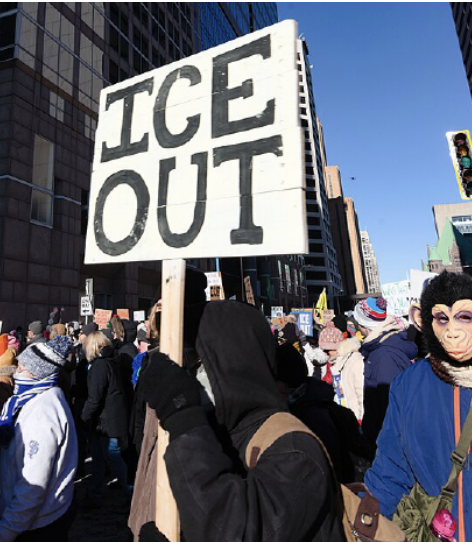
Moreover, attempting to divorce political opinions from a person can often require a privilege to be able to look past a lack of respect for others. For me — Zahaan — the significance of political beliefs is derived from everyday racialized experiences. I have to carry a photo of my passport on the front page of my phone since I live with the constant fear of being detained by Immigration and Customs Enforcement (ICE), especially since racial profiling was explicitly legalized by the Supreme Court in September, according to The Guardian.
I’ve had friends who made light of this situation, whether it be a joke claiming that they will “call ICE” on students at Poly Prep they dislike, or a genuine belief that “illegals” don’t belong in this country. While someone of a different racial identity will likely never experience the fear I do, that does not excuse apathy, and choosing to remain friends with people who would make light of my experience is both invalidating and threatening.
This experience is not solely an individual one; a student survey conducted by The Brown Daily Herald found that marginalized students disproportionately prioritized political values when deciding whom to befriend. For Black and non-straight students, over 80% “selected that political beliefs were ‘important’ or ‘significantly important’ when forming friendships,” compared to 67.7% of white students and 57.1% of straight students.
According to The Daily Herald, marginalized students feel the need to prioritize politics because they “feel that their individual rights are in danger, [and] may have a greater need to ensure there’s ‘political scaffolding’ around them to ensure the freedoms relating to their identity are protected.” Thus, politics should be prioritized for all people when entering a friendship regardless of whether or not you are marginalized, as ignoring them risks enabling the ideologies which oppress marginalized people.
However, as Polygon Editor-in-Chief, Carolina Lisk ’26, argued in the Polygon op-ed, “Separating the Person From the Politics,” one might say that prioritizing politics can both exacerbate polarization and make it difficult to preserve friendships. In an anecdote, she explained that a negative response to her friend’s voting preferences “made the voter feel ashamed [and] deterred her from sharing her political opinion again,” highlighting how judgement poses a risk to both relationships and democracies at large.
However, we are not arguing that denigration is a warranted response to someone’s politics, nor that they should stay silent about them. Rather, we believe that if someone vocalizes a concerning political stance, then expressing concern and judgment can be both a form of necessary self-preservation and a means of educating others. Learning about the implications of your politics is thus both a prerequisite to quality friendships and political action uncorrupted by political dogma.
Politics can no longer be a mere consideration in friendships. Given how much modern politics has come to defend oppression, dehumanization and violence, you have to stop and ask yourself, “what does my friend endorse?” And if, when considering this, you discover that ignorance is required to preserve your friendship, then you should begin to question that friendship’s value.