








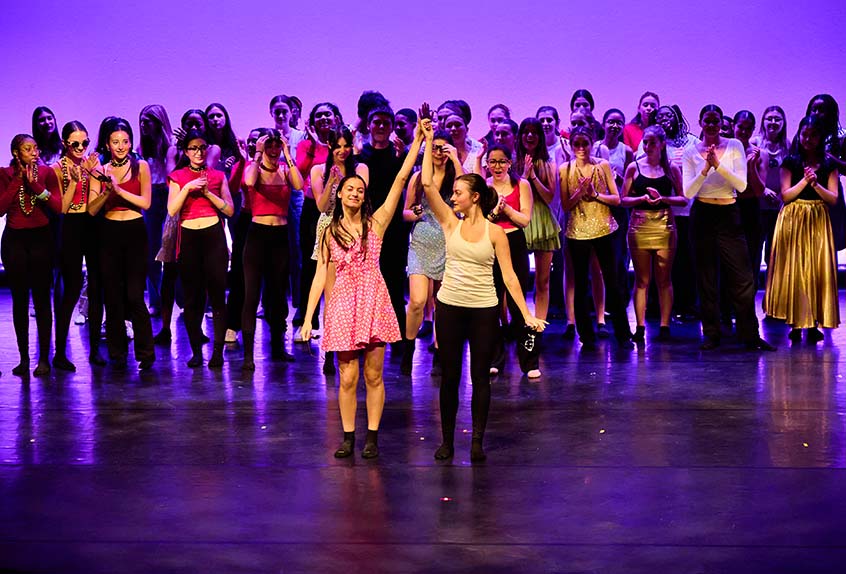










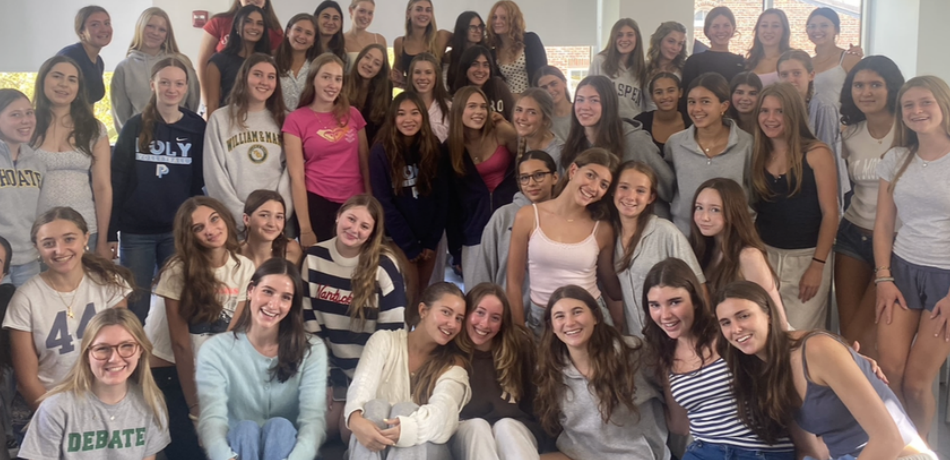
With more than forty Upper School student participants, Women’s Affinity remains one of Poly Prep’s largest Diversity, Equity, Inclusion and Belonging (DEIB) groups. To ensure each of the affinity’s meetings has a meaningful impact on all of its participants, the group has been rethinking the topics that each meeting covers, and their relevance to the group’s participants, while ensuring that they are discussed in an engaging way.
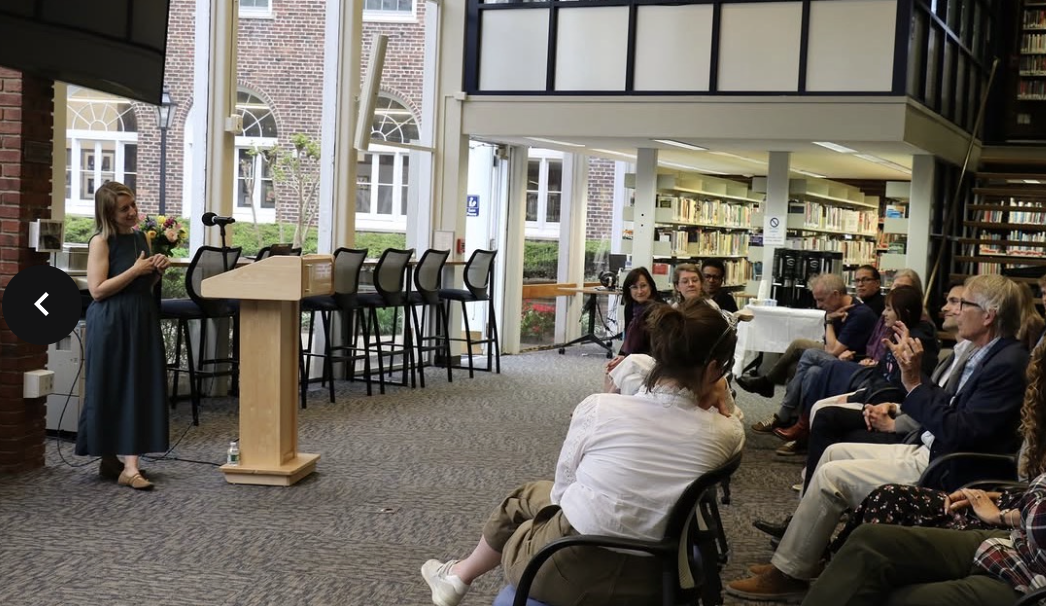
This year, the Women’s Affinity group has centered many of its discussions on women’s health. Over the course of two sessions, Phoebe Aberlin-Ruiz, Health and Wellness Faculty and Leader of Middle School Women’s DEIB group, visited Women’s Affinity for an open discussion on women’s bodies, women’s sexual health and sexual assault. “The talk got people out of their comfort zones, most people engaged just because they had so many questions.” said Lauren Pauls ’27, a Discussion Leader for the affinity group.
Building on these conversations, the group watched the Oscar-winning Netflix documentary short, titled “Period. End of Sentence.” The film features women in rural India fighting menstruation stigma by manufacturing their own low-cost sanitary napkins, according to the International Documentary Association (IDA). “Even in 2026, these conversations can still feel taboo. We talk a lot about normalizing the ways we talk about periods, and yet still it can make you feel nervous and it can still feel weird. I think leaning into that and still talking about it is key,” said Virginia Dillon, History Department Chair and a Faculty Advisor of Women’s Affinity. “Even just talking with my friends, I find myself becoming more passionate about taking down the barrier of embarrassment around periods. I think that’s something the school hasn’t addressed as much as it could,” Pauls noted.
Inspired by the film, Eliza Rorech ’26, Women’s Affinity President and Co-chair of the Service Learning Team and Bridge Committee, has been exploring the future possibility of hosting a menstrual product drive. “I wanted to incorporate service into the group a little bit this year, so people feel like it’s a space where change is being produced,” she said. Twenty-four percent of teens struggle to afford period products, according to a State of The Period Study conducted by the Harris Poll in 2025, an issue Rorech hopes to address. Rorech’s initiative relates to the goal that her and the Women’s Affinity Vice President Rose Filippazzo ’27 (Breaking News Editor of The Polygon) set: to tie every lesson and discussion to a tangible project, activity or outcome. “Always having something physical that we can tie our progress to was very important to us,” said Filippazzo.
During the group’s first meeting, they created a time capsule of letters written by current members to future women at Poly. Within these letters, members of the group wrote about their present experiences as women in this time period, and as women at Poly. In addition, they posed questions to future women at Poly about how life as a woman has changed as years have gone by. “Being able to have this group make a direct impact on future generations of [the] women at Poly who discover it in twenty years is so important and has such a lasting impact on Poly’s community of women,” said Filippazzo. “It was such an amazing experience to be able to connect to the future generations of girls at [Poly]. I think it’s so great to know that we get to share our memories with them, which they’ll be able to compare with their own,” noted Sadie Hart ’28, a member of the affinity group.
In the most recent meetings, Women’s Affinity has been partnering with the Unidad Affinity for group discussions and activities. In past years, collaboration with other affinities for the Women’s Affinity group often centered on discussions with Male Allies. “Partnering with Unidad was a way to diversify the voices being shared within our group since it’s mostly white women. In previous years, I think there’s been a lack of conversations surrounding women of color and women in the LGBTQIA+ community because of that,” Rorech said. Together, the groups discussed machismo, a cultural concept tied to traditional expectations of ultra masculinity that can shape gender roles, according to Zacharias Sexual Abuse Center. Students then discussed how those expectations can contribute to unequal power dynamics and, in some contexts, domestic violence. “Having a combined discussion with the members of Unidad about a topic that affects both of our communities was so impactful and really diversified the group’s focus. I was especially interested in the ways that women came together in colorful protests to support the machismo women,” said Lucy Fleishhacker ’28, one of the Women’s Affinity members.