





















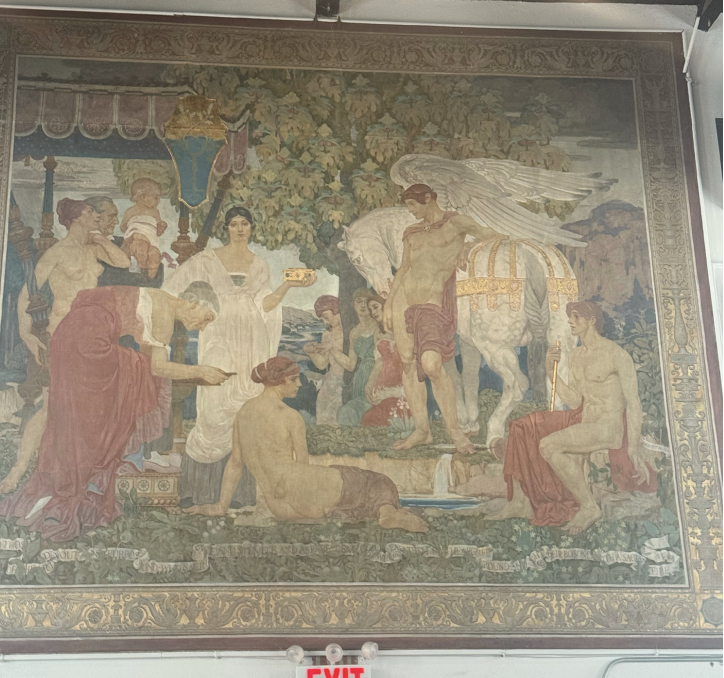
As you walk into Poly Prep’s Commons Dining Hall, you will probably first admire the historic room with the creaky, antique benches and wooden walls. The salad bar in the middle of the room will probably tempt you to continue on and head to either side of the large white wall to explore the variety of main-course meals. When you round the corner, however, to face the grand Commons entrance, you are not likely to tilt your head up above the entranceway. If you do, though, you are likely to crease your brows and question the huge image above the large entranceway: a painting such as those you would find in some of the most recognized museums in New York City.
In 1915, “A Journey to Parnassus” was painted by Eugene Savage, “an American realist and surrealist painter known for his mural, genre, figure and landscape works,” according to Syracuse University Libraries and Special Collections Research Center. The painting was not initially meant to come to Poly. However, a fire at the federal building it was meant to be displayed at in Manhattan, led to the painting’s unanticipated arrival at Poly in 1921. Poly Alum, Jean Mary Bongiorno ’93, further described that the mural was only initially meant to be at Poly “on a permanent loan basis in 1921, but later on it was re-donated to Poly by the artist himself,” in an article she wrote for her final senior project, which was further published in the 1993 Fall issue of the Poly Prep Magazine. The painting has hung on the same wall of Commons for the last 105 years.
Savage studied “at the Art Institute of Chicago and was a fellow in visual arts at the American Academy in Rome in 1915. He later earned a bachelor’s degree (1924) and master’s degree in fine arts (1927) from Yale University, where he also taught during the 1920’s,” said the U.S. Commission of Fine Arts. Savage became a well-renowned sculpturist and muralist. In 1933, Savage “was appointed a member of the Commission of Fine Arts for Painting by President Hoover… and was reappointed by President Roosevelt in 1937,” said Bongiorno in her article.
Savage spent a few years in Rome from 1912 to 1915 when he was studying at the American Academy in Rome. Savage fell “under the spell of that ancient city [and] the young artist began to render historic figures that were suitable for the classic style needed for mural painting in the traditional manor. During this period he was able to study and observe Roman and Greek sculpture… this method survived and was used efficiently throughout Europe and the United States,” said the William Vareika Fine Arts LTD website.
Right at the end of his stay in Rome, Savage began composing his work ‘A Journey to Parnassus’ as a tribute to the traditional artistic techniques he had encountered in the ancient city. Savage chose to focus his painting on Mount Parnassus which, according to the website of Museo Del Prado, “was the mountain where Apollo, the god of the sun, arts, and poetry, lived according to Greek and Roman mythology.” In her article, Bongiorno recognized that when Eugene Savage painted ‘A Journey to Parnassus’, he had “sent it first to Italy to enter a contest. The painting won The Prix de Rome.”
By 2004, the painting was exactly where it was first instituted eight decades earlier; on the front wall in the Commons Dining Hall. This year marked the 150th anniversary of Poly’s academic institution and questions began to arise about the painting that seemed almost out of place among the ‘Juicy’ sweatpants and ‘Miss Me’ jeans. The event invoked a desire to establish Poly archives as they had not previously been organized and recognized. A group of volunteers decided to honor the legacy of Poly’s 150th-year anniversary by creating a book about the history of the school. Among these volunteers was Robert Aberlin.
Robert Aberlin, a former—and now retired—Chief Finance Officer at Poly, described the process of creating the book. “We hired an archivist, and we found things and put them all together in a couple of places; they were all over the school,” said Aberlin. He continued, “We started to do some research on old alums, some of the art and some of the other things that are around that you probably don’t even know about… It was all part of trying to establish an archive and understand what the school had and put it in one place,” said Aberlin.
As the organization of the archives continued, Aberlin was pointed to Bongiorno’s Senior project in the form of an article titled ‘A Journey to Parnassus’. Bongiorno graduated Poly in 1993 and recalled much of her experience as a student at Poly and with Savage’s painting. “I always took note of ‘The Journey of Parnassus’ painting in Commons and had always had more questions than answers,” said Bongiorno in a recent interview. She has come back to visit Poly a number of times since she graduated and initially “[could] not remember a blessed thing about [the mural],” said Bongiorno, previous to her re-reading of her article from 1993.
The Poly version of the painting is very similar to the painting kept in the Prado Museum in Madrid, Spain, titled Parnassus painted by the French painter Nicolas Poussin in 1631. Like Poussin’s piece, Savage chose to have the figures in his painting at the center of his canvas and some to be nude or have loose, regal clothing on.
Anthony Gini, Classical and Modern Philosophy Department Chair at Poly, expanded on the elements of Savage’s piece. “This is the Castallion Spring, the one that Apollo is residing over and is like the fountain of wisdom,” said Gini. “The figure in the front who is very prominent might be Aphrodite, the one in the back… could be Demeteur. And there is a town in the back that is supposed to refer to some contemporary town. He kind of went to town, putting whatever iconography he felt like illustrating.”
Flora Jakobson ’27 said that “whenever I walk into Commons, I always notice this one gold part of the painting that catches my eye.” Gini was also stricken by “the gold plated details” on what he described to be Pandora’s box. The myth of Pandora’s box is that Pandora was created as per the request of Zeus and was given “many traits including beauty, curiosity, charm, and cleverness,” according to the National Gallery of Art. “Zeus handed [Pandora] a beautiful box” and was told “‘don’t ever open it’… [but] Pandora’s curiosity got the best of her, and she opened the box, ending earthly paradise. From the small chest flew troubles and woes—sorrow, disease, vice, violence, greed, madness, old age, death—to plague humankind forever. However, Zeus did not realize that hope had been secretly added to the box… When Pandora opened the box and released trouble and woe into the world, hope was there to help people survive,” the website continued. This hope that was among the other “troubles and woes” is representative of the “devoted advocate of academic painting” that Savage was, said the Taylor Graham website.
Bongiorno reflected on the atmosphere that has evolved within the same Poly walls since the initial installation of the piece. “When you think about this kind of ‘dead poet society’ type of prep school that was once all-boys, is now co-ed, still has this strict dress code and does have this college prep vibe, if you will – very much run like a miniature college. Having paintings like that in your dining room totally made sense. Because that’s exactly what was happening. Today, I think it seems even more out of place, like kids go ‘What in the world is that?’” said Bongiorno.
Bongiorno further explained the elements of Savage’s piece in the context of the Poly student body and the contrast in educational trends from both the 1920s and the present-day. She said, “If you’re this college prep school kid in [the] 1920’s, you’re studying Greco-Roman stuff all the time, you’re taking Greek mythology and Roman architecture” it was fitting to eat lunch in a dining hall with ‘A Journey to Parnassus’ at the center of the dining area. She continued, “It’s all in the same vein of the classics. That was what education was based on. Now fast forward to 2026. This is not the case. But I think that the painting in Commons is the last vestiges of that [Greco-Roman education].”
Students at Poly have questions and have made their own observations about Savage’s mural. Caterina Cascella ’27 said that “in middle school, we would always say and recognize, ‘we’re eating and there’s naked people on the wall’… but I definitely can appreciate the painting a lot more now.” Phoebe Aberlin, Health and Well-Being Faculty, has been at Poly for several decades and said, “Most years, usually around March or April, the fifth graders realize that there’s boobs. And you could watch it happen during lunch.” She continued, “They’re like, ‘oh my God, naked people.’ And there’s a flurry of talk about it. And they don’t say anything to adults, but you can watch because they’re pointing.”
There is so much context and so many stories attached to a piece of artwork, with Savage’s work being a tribute to the stories of the past. Without context, all we see is a large illustration that feels out of place with nude women and a horse with wings. Robert Aberlin recognized, “most people know [the work] is there, but they never look at it… you look at things throughout the school and people don’t realize, now, what’s really there.”