





















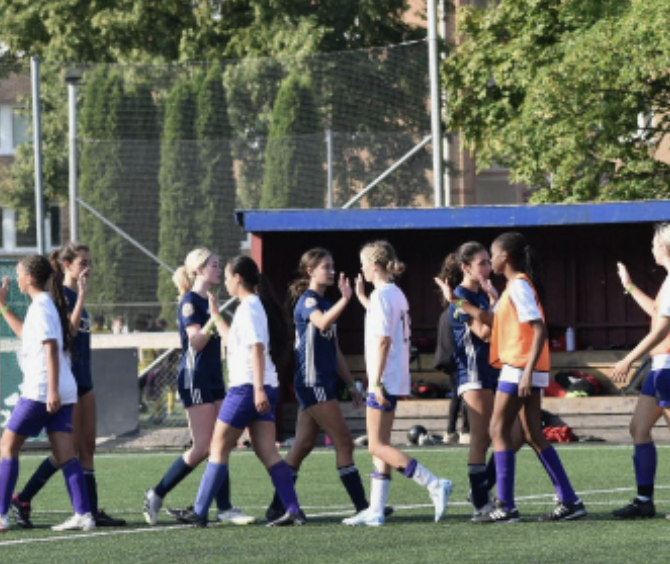
Poly Prep is home to many successful athletes whose achievements on the home-fields are widely recognized, but there are also a variety of athletes who dedicate themselves to athletics outside of school. This involvement includes clubs, travel teams and other amateur leagues that extend beyond Poly’s own sports schedule. Along with the taxing responsibilities of being a student, these additional athletic commitments demand time, discipline and effort. Though Poly does a successful job of offering many rigorous practices and games for its teams, some student-athletes seek this extra training. Participating in athletics outside of school often means sacrificing weekends, evenings and school breaks in order to fulfill the dual athletic requirements.
Playing sports outside of school can entail different responsibilities for different athletes. Emma Lattinelli ’27 played on an all-year-round softball team for six years, with consistent practices, games and showcases; a commitment that is not unnoticed in her outstanding contributions to Poly Varsity Softball. Lattinelli shared that the team began by teaching her softball basics, such as fielding the ball. As she got older, the team helped with building specific, more advanced skills, such as “tracking the ball,” and an overall sense of confidence and consistency. Another athlete, Benicio Quinones ’27, played on a travel baseball team during the summer, which held occasional practices and games with other baseball teams across the United States. Lattinelli and Quinones, along with many other Poly students, dedicate time to improving their athletic skills and building resilience. This, in turn, helps them build time-management habits and confidence within their sports.
One of the most distinct aspects of out-of-school athletics is the year-round nature of the training. They allow consistent progress and preparation for the school season, when you can build team strength and showcase your skills. It introduces athletes to diverse coaching and teammate skills that improve athletic performance at many levels. That extra training allows student-athletes to be both prepared for their school season and explore sports that are not available at school.
“I didn’t have a school lacrosse team until I got to high school, so I had to do an outside-of-school team or else I wouldn’t play at all,” described Sienna Klauss ’26.
While stressful, out-of-school athletics can consume a significant part of many students’ lives and offer them new, exciting opportunities. Nonetheless, the eager student-athletes at Poly can start to feel overwhelmed by an overpacked schedule. Balancing classes, hours of homework, weekend social commitments and demanding practices can feel overwhelming for many student-athletes who just want to take advantage of their opportunities.
“You have to take your work seriously when you can because practice takes up a lot of your time. You’ll get home at 7 p.m. from Poly’s practice and then have more practice after that,” Charlie Garner ’27 explained regarding his soccer commitments.
This dedication is not only a clear representation of an athlete’s passion for their sport and personal improvement, but also an opportunity to showcase their talent to colleges. “It’s great for recruitment. In all the club’s tournaments, they are pretty much showcases for college scouts,” Montauk Margolies ’26 explained. For many athletes, these showcases are the difference between being noticed and being overlooked, adding another layer of purpose to their off-campus training.
The culture and training tend to differ between school and out-of-school teams due to time constraints, team values and the diversity of athletes. Student athletes explained how their club teams consist of athletes focused on constant and focused improvement. This dedication differs from school teams, where factors like P.E. credit or spending time with friends play roles in participation. This contrast can make out-of-school practices feel more specialized or competitive, while school teams can offer a broader sense of community and school pride that makes the teams like no other. “It’s a brotherhood. You go to school with these kids, and you’re basically around them all the time, and you have to go through these hardships, like insane conditioning, but it creates a bond that you don’t have elsewhere,” said Quinones.