











Introduction
The Indiana Hoosiers (IU) won the national championship against the Miami Hurricanes in Florida, 1,166 miles from their home in Bloomington, Indiana. For the Hoosiers, the road to the College Football Championship meant not only putting miles behind them but also a past defined by disappointment. Before the 2025 season, the Hoosiers held the record of the most losses in College Football with 715 losses, until Northwestern surpassed them this November. Not only that, but they had zero double-digit wins since 1887 and had had nine different coaches between the years of 1982 and 2023, until Curt Cignetti showed up to Bloomington and turned it around for the Hoosiers. Now the team has, against all odds, become the best program in the country. Creating talented players out of lackluster three and four star high school recruits. A key example of this is star Quarterback Fernando Mendoza, who came to UC Berkeley as a two star recruit before flipping to IU two years ago. Mendoza is now not only a Heisman award recipient, but is a national champion and the consensus number one pick in the NFL draft. A true underdog story.
Selection
Besides the excitement felt by Hoosier fans around the country, the College Football Playoffs (CFP) this year were exciting for many teams. For instance, the second year of the twelve-team format allowed many teams that would not have previously had a chance to compete for the National Championship to play. For example, the University of Miami’s Hurricanes, the second-place team, came into the CFP as number 10 on the rankings, which means that in the original four-team format, they would have missed out by six teams. The final bracket drew much controversy as it left out many teams in more difficult conferences in favor of teams with greater records and conference championships, even if the conference championships were in easier conferences. For example, Tulane University’s Green Waves, which won the AAC, and James Madison University’s Dukes (JMU), which won the SBC, entered the playoffs instead of several other programs that play in the more rigorous, power four conferences, the ACC, SEC, Big 10 and Big 12. Notre Dame’s Fightin’ Irish and Brigham Young University, for example, despite being ranked highly in preliminary polling on who would make the playoffs, were passed up due to their failure to win a national championship. Notre Dame was especially angry, choosing to sit out their bowl game, since, as an independent team, they do not participate in any conference championship. Additionally, JMU and Tulane surpassed many three-loss teams who were originally ranked higher than JMU and Tulane due to the competitive conferences they play in. This includes teams like Vanderbilt and Texas, who were initially ranked 14 and 13, respectively in the CFP preliminary rankings.
In the end, as a result of the selection committee’s decision to prioritize conference championships and record over strength of schedule, the CFP included a very diverse pool of teams from around the country, including: three Big Ten teams, five SEC teams, one SBC team, one Big 12 team and one ACC team. With the SEC, Big Twelve and Big Ten—the University of Georgia’s Bulldogs, Texas Tech’s Red Raiders and Indiana, respectively—along with The Ohio State University’s Buckeyes, receiving byes to the second round.
Round 1, Dec. 18-19
Although exciting, the two non-power four teams’ playoff run was short-lived. Tulane lost to the Ole Miss Rebels in Oxford, Mississippi, with a final score of 41-10. James Madison also lost to the Oregon Ducks in Eugene, Oregon, with a score of 34-5.
The other two games,between tenth-seeded UMiami and seventh-seeded Texas A&M’s Aggies and ninth-seeded University of Alabama and eighth-seeded University of Oklahoma were more even. UMiami played in College Station, Texas, where they ultimately left with a 10-3 victory against the Aggies. The scoring was ultimately kept to a minimum because of 30 mph gusts, which hampered the passing and kicking game each time, along with UMiami’s monster defense, which is considered the best in the country. Despite this, Miami’s Malachi Toney, a sophomore wide receiver, managed to score the game’s sole touchdown in the final two minutes of the game, propelling the Hurricanes to a victory. The Alabama vs. Oklahoma game ended with a score of 24-34, propelling the Crimson Tide to a round two matchup against the Indiana Hoosiers. Oklahoma initially had a 17-0 lead late into the second quarter; however, by the end of the half, cornerback Zaebian Brown closed the gap with an interception, which he returned for a touchdown, leaving many fans impressed.
Round 2, Dec. 30 – Jan. 1
The second week of the college football playoffs also yielded two major upsets: UMiami’s win during their Cotton Bowl over Ohio State and Ole Miss’s win over Georgia. UMiami’s defense also performed, totaling five sacks and two interceptions, ultimately holding the Buckeyes to a total of -3 rushing yards in the first half. Still, the Buckeyes finished with a combined 332 yards.
Ole Miss’s 34-39 Sugar Bowl victory against Georgia was a much more tense and action packed game. Trinidad Chambliss, Ole Miss’s quarterback, passed for 362 yards and threw for two touchdowns.
The Rose Bowl, played between Indiana and Alabama, and the Orange Bowl, played between Texas Tech and Oregon, were much more lackluster. In the Rose Bowl, Indiana dominated Alabama with a 38-3 victory over the Tide. Specifically, the Hoosiers had 407 passing yards compared to Alabama’s 193, and held Alabama to a mere 23 rushing yards. Oregon also had a very dominant performance, beating the Texas Tech Red Raiders 23-0. This victory was fueled by Oregon’s defense. Oregon also totaled 16 more minutes of possession than Texas Tech throughout the game. The two dominant games further fueled scrutiny against the selection committee and the expanded 12-team playoffs, as games, especially in the second round of the playoffs, should be the most exciting of the season and should thus never be one-sided.
Round 3, Jan. 14-15
The college football semifinals included two games: one between UMiami and Ole Miss, and one between Indiana and Oregon. Indiana’s win over Oregon resulted in a score of 56-22. Fernando Mendoza threw five touchdown passes while the team’s defense forced three turnovers. Despite having fewer total passing yards than Oregon and almost equal possession time, the Hoosiers capitalized on each possession, dominating the Ducks. Thus, through two terrific performances, what was once the losingest team in college football made the national championship.
UMiami’s victory over the Ole Miss Rebels resulted in a 31-27 score. Carson Beck, UMiami’s quarterback, threw for a total of 268 yards and two touchdowns. While UMiami’s kicker Lucas Carneiro made two long-range field goals, one from 54 yards and another from 58. UMiami also totaled 41 minutes of possession, more than double Ole Miss’s 18 minutes. The Rebels ultimately struggled against Miami’s defense, as shown by a 2 out of10 third-down conversion rate. As a result, the Rebels did not make it to the National Championship.
The National Championship, Jan. 25
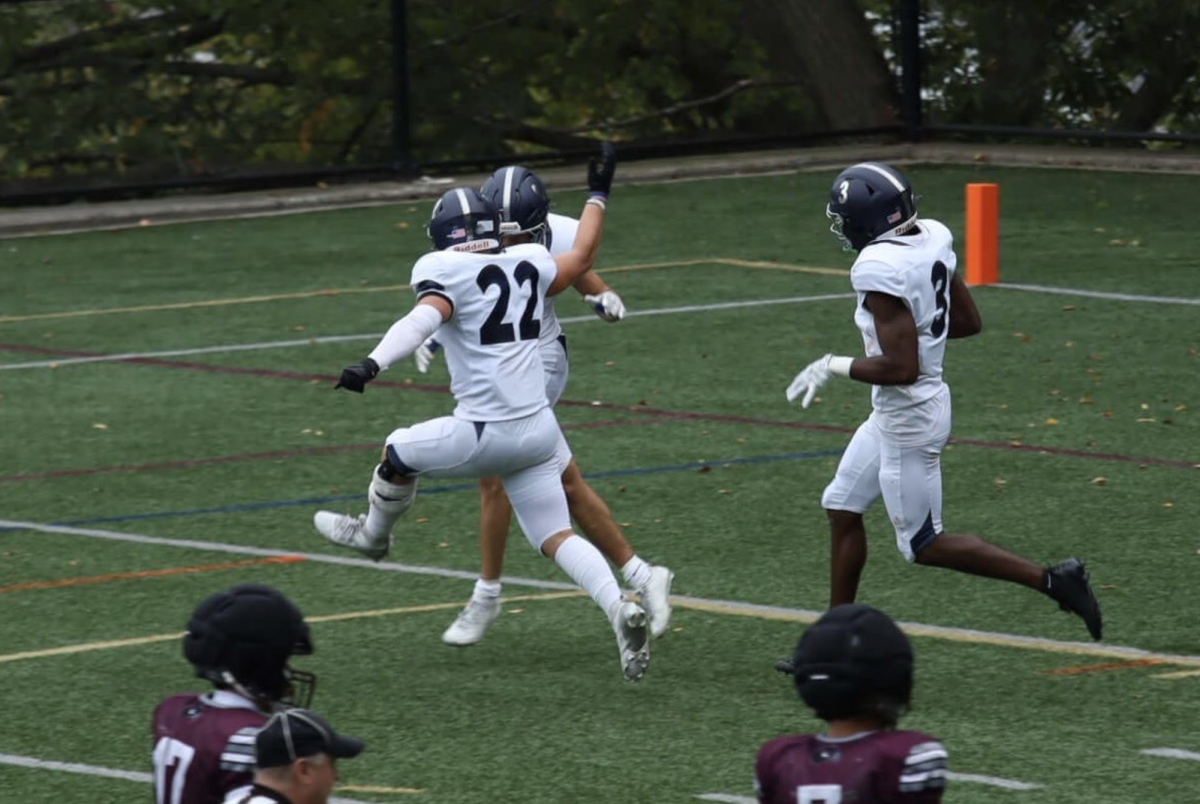
The National Championship game between the Miami Hurricanes and Indiana Hoosiers was particularly exciting for UMiami fans, since its location at Hard Rock Arena in Miami, Florida, meant that the Hurricanes could play in their home stadium. The game started out slow, but it grew tense in the fourth quarter where almost half of the scoring plays took place. Indiana started out with a 10-0 lead going up until the second quarter. However, soon UMiami’s Mark Fletcher Jr. then scored a 57-yard rushing touchdown. The Hoosiers would not answer for another six minutes until Isiah Jones returned a blocked punt for a touchdown. In the fourth quarter, Fletcher Jr. scored another touchdown, which Fernando Mendoza answered with a rushing touchdown. UMiami’s Malachi Toney then scored another touchdown, bringing the game to 21-24, creating a three-point-distance between UMiami and Indiana. However, in the final minutes of the game, Indiana scored another field goal and defensive back Jamari Sharpe caught an interception, ending the game with a final score of 21 – 27.
Reactions within the Poly community
After the National Championship, Poly Prep’s halls were buzzing with chatter and debate about the CFP. Many of Poly’s Hurricane fans were not pleased with the outcome of the championship game, as one of Poly’s Hurricane fans Josh Lippert ’28 stated “I was devastated.”. Still, Lippert expressed he is “proud of how we got to this point” and loves “the players on the team.” Differently, one Indiana fan in particular, Miles Frank ’27, expressed how much the title meant to him, “As a Jets and Hoosier fan, you get used to being the underdog, so seeing Indiana win on this stage meant everything.” To many, this championship was the perfect example of an underdog story. “It also showed that being the higher seed or having the best recruits doesn’t mean everything,” as Indiana won through their “hard work and determination,” he continued. He believes that the team got this far because of the team’s “strong senior leadership in Ruben Bain and Carson Beck;” however, he believed “Beck really struggles in big moments” and thus dropped the ball when it mattered. Though he is upset, Lippert believed that the team’s “young talent” will yield more great results in the future. Though not everyone felt the taste of victory, inside Indiana’s victory against all odds is a message that no matter where you start, hard work can help you achieve greatness.